
The modern food delivery ecosystem is driven by continuous, high-velocity data generation across platforms such as Zomato. Every restaurant listing, menu update, pricing change, and customer interaction contributes to a massive, evolving dataset that reflects real-time market behavior. In this context, Zomato Restaurant Data Scraping Services have become essential for enterprises seeking structured intelligence from this highly dynamic environment.
Organizations use Scraping Zomato Restaurant and Menus Data to extract granular insights at restaurant and menu levels, enabling competitive benchmarking, pricing optimization, and demand forecasting. These datasets are not static; they evolve continuously with consumer demand, seasonal fluctuations, and regional competition intensity.
The increasing adoption of Zomato food delivery data Scraper systems reflects the need for automated, scalable pipelines capable of capturing real-time changes in menus, pricing, and restaurant availability. In parallel, hybrid systems integrate method to Extract Data Using Zomato API to access structured endpoints where available, improving accuracy and reducing scraping overhead.
Together, these methods support the creation of structured intelligence layers such as Zomato Food Delivery App Datasets, which serve as foundational inputs for analytics platforms, AI models, and business intelligence dashboards. The overall ecosystem has shifted from simple data extraction to predictive food market intelligence.
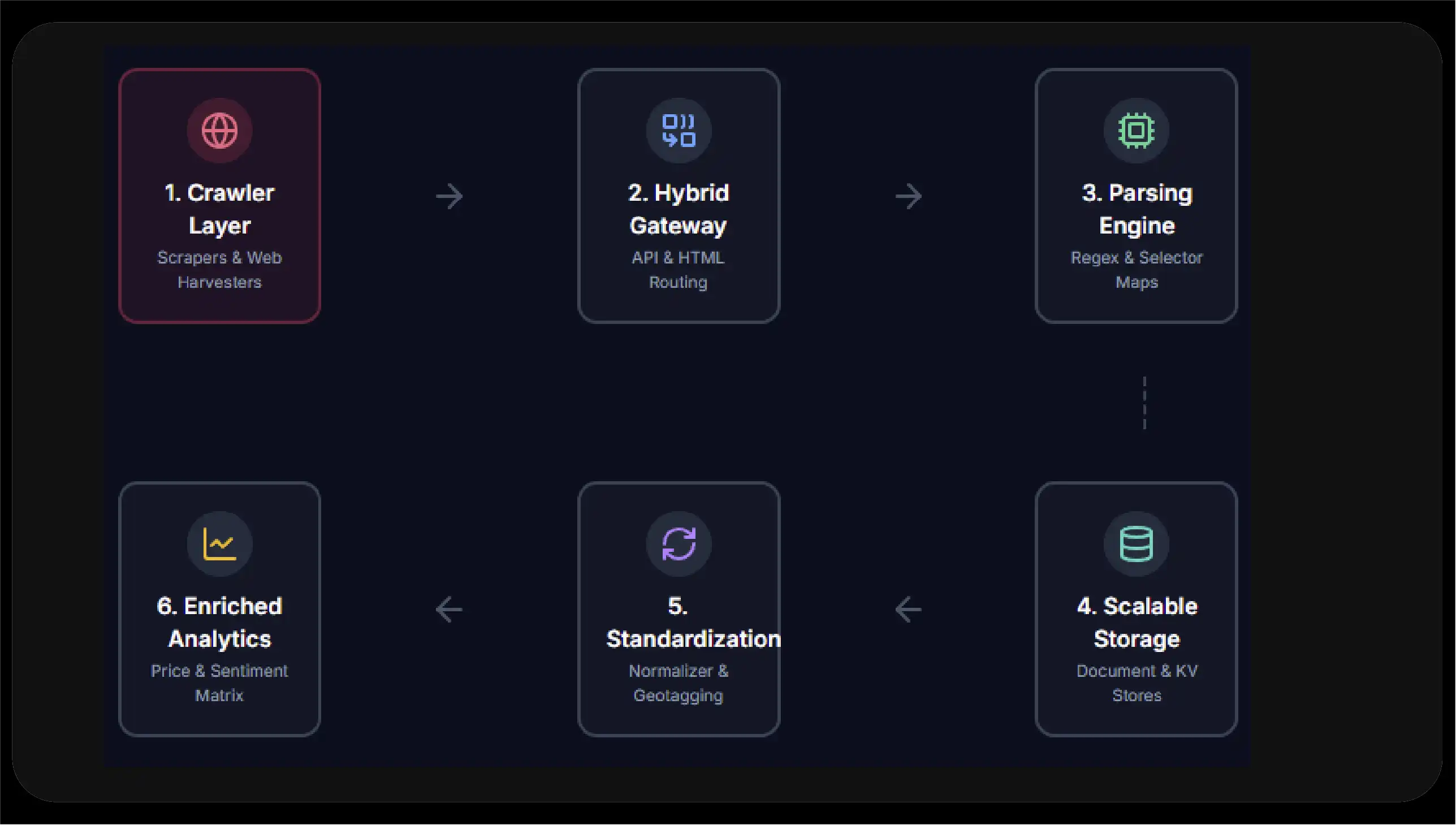
Zomato data extraction systems are typically built using a multi-layered architecture designed to handle high-volume, high-frequency data streams. At the base level, crawlers collect restaurant listings, menu pages, and review data. These are processed through parsing engines that convert unstructured HTML or JSON responses into structured formats. The cleaned data is then stored in scalable databases and used for analytical modeling.
A key characteristic of these systems is their hybrid nature, where scraping and API access are combined. While scraping captures publicly visible web data, API-based methods improve structured access and reduce latency. This dual approach is increasingly used in Zomato Food Data Extraction Services, especially for real-time intelligence systems.
Data standardization is a critical step in the pipeline. Restaurant names, dish categories, and pricing formats often vary across cities and regions, requiring normalization before analysis. Once standardized, the datasets are enriched with geographic tagging, sentiment scoring from reviews, and temporal pricing attributes. This enables deeper insights into consumer behavior and restaurant performance trends.
| Restaurant ID | City | Cuisine Type | Avg Price (₹) | Rating | Delivery Time (min) | Discount (%) | Order Volume Index |
|---|---|---|---|---|---|---|---|
| R101 | Delhi | North Indian | 480 | 4.3 | 32 | 10 | 87 |
| R102 | Mumbai | Fast Food | 350 | 4.1 | 28 | 15 | 92 |
| R103 | Bangalore | Italian | 620 | 4.5 | 35 | 20 | 78 |
| R104 | Hyderabad | Biryani | 520 | 4.4 | 30 | 12 | 95 |
| R105 | Pune | Japanese | 880 | 4.6 | 40 | 8 | 65 |
| R106 | Kolkata | Bengali | 300 | 4.2 | 25 | 18 | 88 |
| R107 | Chennai | South Indian | 270 | 4.0 | 22 | 5 | 91 |
| R108 | Ahmedabad | Street Food | 220 | 3.9 | 20 | 25 | 96 |
The dataset demonstrates clear structural variations in pricing, demand, and delivery performance across cities. High-volume cities such as Mumbai and Ahmedabad show strong correlation between discount intensity and order volume index. Premium cuisine segments like Italian and Japanese exhibit higher pricing but lower order frequency, indicating price-sensitive demand elasticity. Regional cuisines such as South Indian and Bengali maintain stable demand despite lower pricing, suggesting strong cultural consumption patterns.
One of the most valuable applications of Zomato data extraction is the analysis of price fluctuations over time. Using strategy to Extract restaurant price trends from Zomato, analysts can identify how restaurant pricing adapts to inflation, competition, and seasonal demand shifts. This includes monitoring discount cycles, promotional intensity, and category-level pricing strategies.
| City | Cuisine | Avg Price Q1 (₹) | Avg Price Q2 (₹) | Price Growth (%) | Discount Frequency (%) | Competitor Density Index |
|---|---|---|---|---|---|---|
| Delhi | North Indian | 460 | 495 | 7.6 | 22 | 85 |
| Mumbai | Fast Food | 330 | 365 | 10.6 | 28 | 92 |
| Bangalore | Italian | 600 | 655 | 9.1 | 18 | 78 |
| Hyderabad | Biryani | 500 | 540 | 8.0 | 25 | 88 |
| Pune | Japanese | 850 | 910 | 7.0 | 15 | 70 |
| Chennai | South Indian | 260 | 285 | 9.6 | 20 | 80 |
| Kolkata | Bengali | 290 | 320 | 10.3 | 30 | 83 |
| Ahmedabad | Street Food | 210 | 235 | 11.9 | 35 | 90 |
The table highlights significant variations in price elasticity across cities and cuisines. Street food categories show the highest inflation sensitivity due to low-margin structures and ingredient volatility. Conversely, premium cuisines such as Japanese maintain more stable pricing structures. Mumbai and Kolkata demonstrate high discount frequency, indicating stronger competitive pressure and higher customer acquisition costs.
Modern systems increasingly rely on Extract Data Using Zomato API in combination with scraping engines to achieve high reliability. API-based extraction provides structured data feeds, while scraping ensures coverage of publicly visible and unstructured elements such as reviews and menu images. This hybrid architecture reduces data gaps and improves system resilience against platform changes.
The evolution of Food Menu Data Extraction Services has enabled deep SKU-level analytics for food delivery platforms. These systems extract detailed attributes such as ingredient composition, dish popularity, combo structures, and item-level pricing. When integrated into Zomato Food Delivery App Datasets, this enables advanced analytics such as menu optimization, demand clustering, and predictive recommendation systems.
Large-scale Zomato data extraction systems face multiple challenges including dynamic page rendering, frequent UI changes, anti-bot mechanisms, and API rate limitations. These issues require distributed scraping frameworks, rotating proxy networks, and adaptive parsing models to ensure continuity and data accuracy.
The extracted datasets are widely used for pricing intelligence, restaurant benchmarking, cloud kitchen optimization, and demand forecasting. Businesses leverage Zomato Food Data Extraction Services to shift from descriptive reporting to predictive analytics, enabling more accurate market positioning and revenue optimization strategies.
The food delivery industry is rapidly transitioning into a data-centric ecosystem where platforms like Zomato generate high-value behavioral and transactional data. Advanced Web Scraping Services enable structured access to this ecosystem, transforming raw platform activity into actionable intelligence.
When combined with Food Delivery App Menu Datasets, organizations gain a comprehensive view of pricing dynamics, customer behavior, and competitive structures. The integration of Web Scraping API Services ensures continuous, real-time data access, making data-driven decision-making a core capability in modern food industry analytics.
Experience top-notch web scraping service and mobile app scraping solutions with iWeb Data Scraping. Our skilled team excels in extracting various data sets, including retail store locations and beyond. Connect with us today to learn how our customized services can address your unique project needs, delivering the highest efficiency and dependability for all your data requirements.
We start by signing a Non-Disclosure Agreement (NDA) to protect your ideas.
Our team will analyze your needs to understand what you want.
You'll get a clear and detailed project outline showing how we'll work together.
We'll take care of the project, allowing you to focus on growing your business.