
6,720
AUTOZONE STORES
Location data scraping reveals how AutoZone and O’Reilly, near-identical in size, win with opposite strategies: national reach versus deep city penetration.
Good location data scraping does more than count stores — it reveals the strategy behind a footprint. We rebuilt the U.S. store networks of two auto-parts giants from public data to show how two near-identical chains compete in completely different ways. This teardown speaks to:
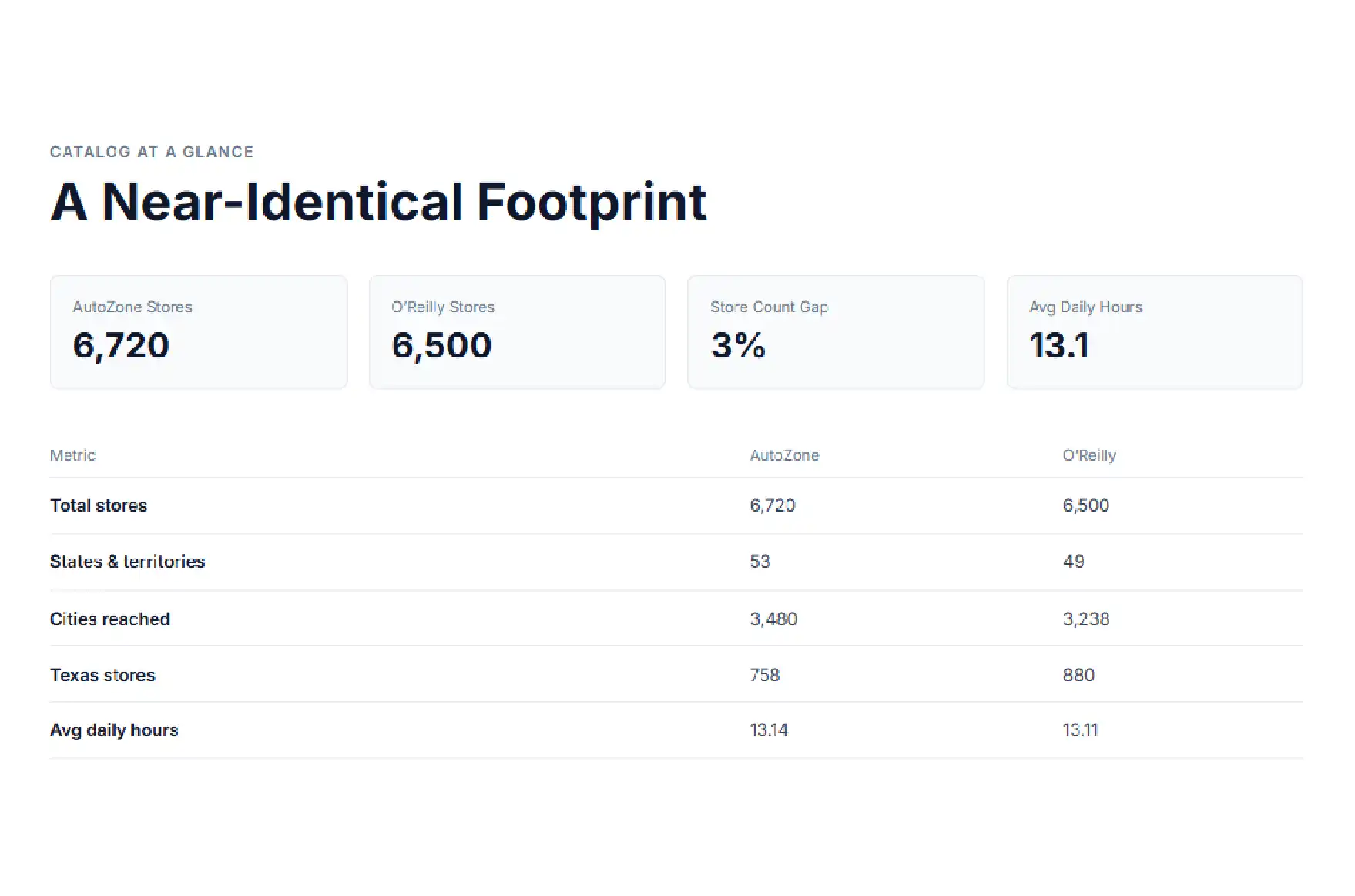
AutoZone and O’Reilly are two of the largest auto-parts retailers in the United States, and at first glance their footprints look almost identical: 6,720 stores versus 6,500, present in 53 and 49 states and territories, open roughly 13 hours a day each. On scale alone, it is hard to say who dominates. The interesting story only appears once you read the location data closely.
Using location data scraping, we reconstructed both networks from public sources: store counts, state and city coverage, the Texas concentration, average operating hours, and the in-store services each chain advertises. Two very different strategies emerge from near-identical totals. AutoZone pushes broad national coverage, reaching more states and over 200 more cities, and positions itself for do-it-yourself customers. O’Reilly concentrates more deeply — Texas is clearly its strongest market — and leans into hands-on, in-store service.
The pattern most comparisons miss is that store count is a vanity metric. Our unique read uses geocoded location data to separate where the two chains actually collide from where each operates uncontested — and, combined with their opposite service models, shows that two stores on the same street may not even be competing for the same shopper. This report walks through six findings and what the same approach reveals about any retail network you study.
A store locator page looks simple, but turning two national networks into one clean, comparable dataset is not. Each chain's locator is built for a single shopper checking one ZIP code, not for bulk collection — so coverage requires sweeping thousands of locations without tripping rate limits, bot detection, or rotating page layouts. Addresses arrive in inconsistent formats, hours are written a dozen different ways, and duplicate or recently closed stores quietly inflate the totals if they are not cleaned out.
Comparing two brands multiplies the difficulty. The fields have to be normalized to the same schema, addresses geocoded to real coordinates, and hours parsed into comparable numbers before any city-versus-city analysis is even possible. Reliable location data scraping is therefore less about pulling a page and more about a resilient pipeline plus a verification layer that turns messy locators into an analysis-ready map.
Here is how a do-it-yourself stack compares with a managed service across the dimensions that decide whether location data is usable.
| Dimension | DIY Scraping | iWeb Data Scraping |
|---|---|---|
| Setup time | Weeks of engineering before clean data | Live within days, scoped to your brands |
| Anti-bot handling | Constant firefighting with blocks and CAPTCHAs | Managed proxy and detection layer |
| Address normalization | Inconsistent formats break comparisons | Standardized, geocoded coordinates |
| Hours parsing | A dozen formats, no clean averages | Parsed into comparable numbers |
| Duplicate / closed stores | Silently inflate the totals | Deduplicated and validated |
| Maintenance | Breaks on every locator change | Pipeline upkeep included |
| Total cost | Hidden in engineering hours | Predictable, decision-ready deliverable |
AutoZone and O’Reilly Auto Parts are direct rivals in U.S. auto-parts retail, and both have spent decades building dense physical networks. They sell to overlapping audiences — everyday drivers, weekend mechanics, and professional repair shops — and on paper they are remarkably evenly matched in store count, geographic spread, and even daily operating hours.
What separates them is intent. AutoZone has historically chased broad reach and built its brand around the do-it-yourself customer. O’Reilly has grown with apparent selectivity, going deep in its strongest regions and building a reputation for hands-on, in-store help. Everything that distinguishes the two is observable in public data — addresses, city and state coverage, hours, and the services each location advertises — which makes the pair an ideal case for turning a tie on paper into a clear strategic contrast.
We approached both networks as a structured collection problem with a verification layer on top. For every store, we captured brand, full address, city, state, and operating hours, then geocoded each location to real coordinates so the two networks could be compared at the state, city, and ZIP level rather than as raw counts.
Every record then passed through validation — addresses normalized to one schema, hours parsed into comparable numbers, and duplicate or closed locations removed so the totals reflect live stores only. We also catalogued the in-store services each chain advertises, then analyzed footprint, state and city coverage, the Texas concentration, hours, service strategy, and the overlap mapping that closes this report.
Side by side, the headline numbers are almost a tie. AutoZone runs 6,720 stores to O’Reilly’s 6,500 — a gap of barely 3 percent. Both keep similar hours and serve overlapping audiences, which is exactly why a surface comparison concludes they are interchangeable.
| Metric | AutoZone | O’Reilly |
|---|---|---|
| Total stores | 6,720 | 6,500 |
| States & territories | 53 | 49 |
| Cities reached | 3,480 | 3,238 |
| Texas stores | 758 | 880 |
| Avg daily hours | 13.14 | 13.11 |
The totals are close, but the strategy behind them is not. Every row in that table hides a different choice — about how wide to spread, where to go deep, and which customer to serve. The findings that follow unpack each one.
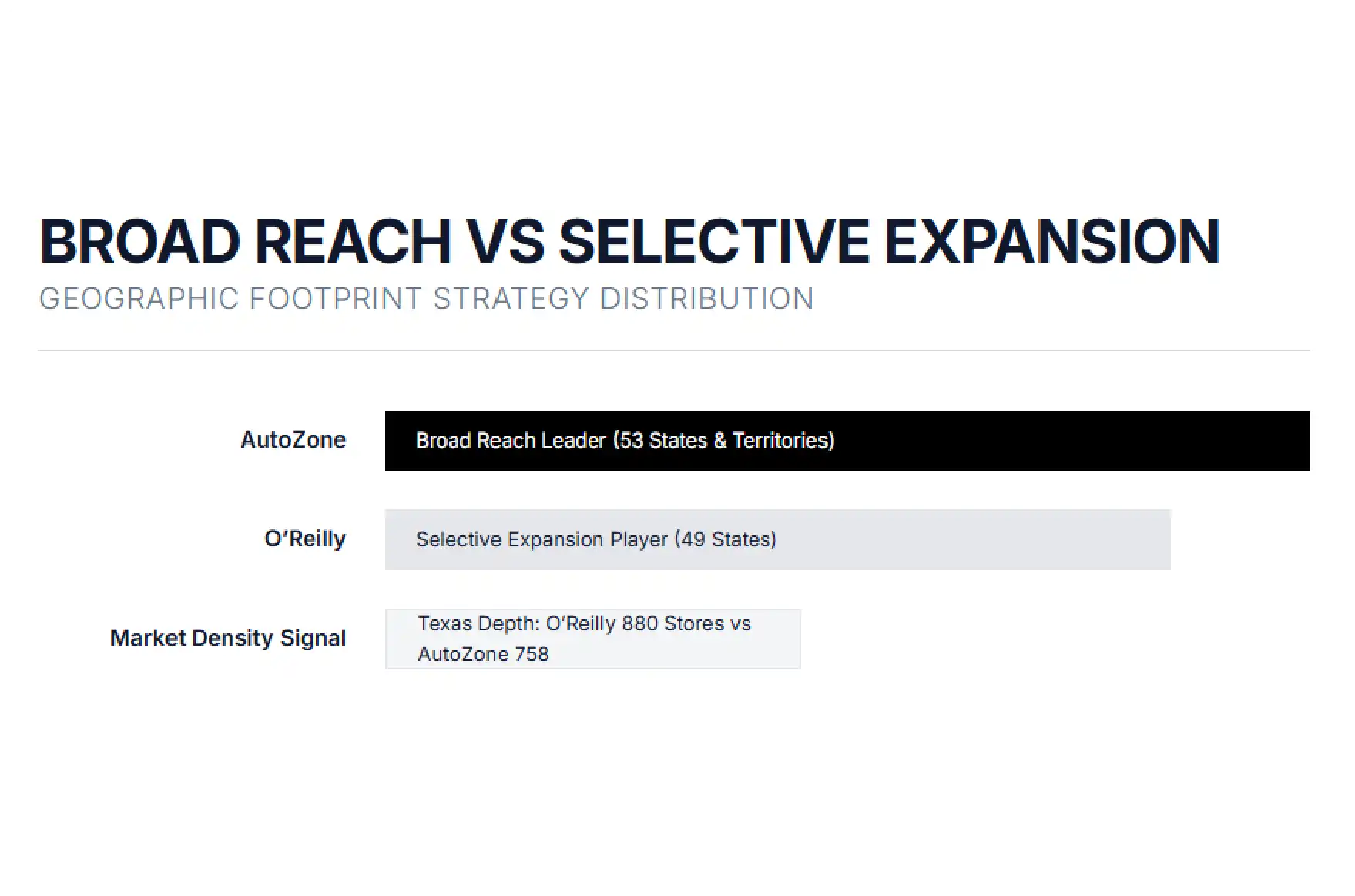
The first real divergence is geographic spread. AutoZone is present in 53 states and territories to O’Reilly’s 49 — a clear sign that AutoZone is pushing for broader national coverage, planting a flag in as many markets as possible.
O’Reilly’s narrower spread reads as deliberate selectivity rather than weakness. Covering fewer states while running nearly as many total stores means it concentrates its locations more tightly, going deeper where it chooses to compete instead of stretching thin to claim a national map. Two near-equal store counts, two opposite philosophies about how widely to spread them.
MAP YOUR CATEGORY THIS CLEARLY
Picture this same store-by-store, city-by-city view for you and your top rivals. iWeb Data Scraping can deliver a clean, geocoded location dataset for any retail network in days. Email info@iwebdatascraping.com to scope it.
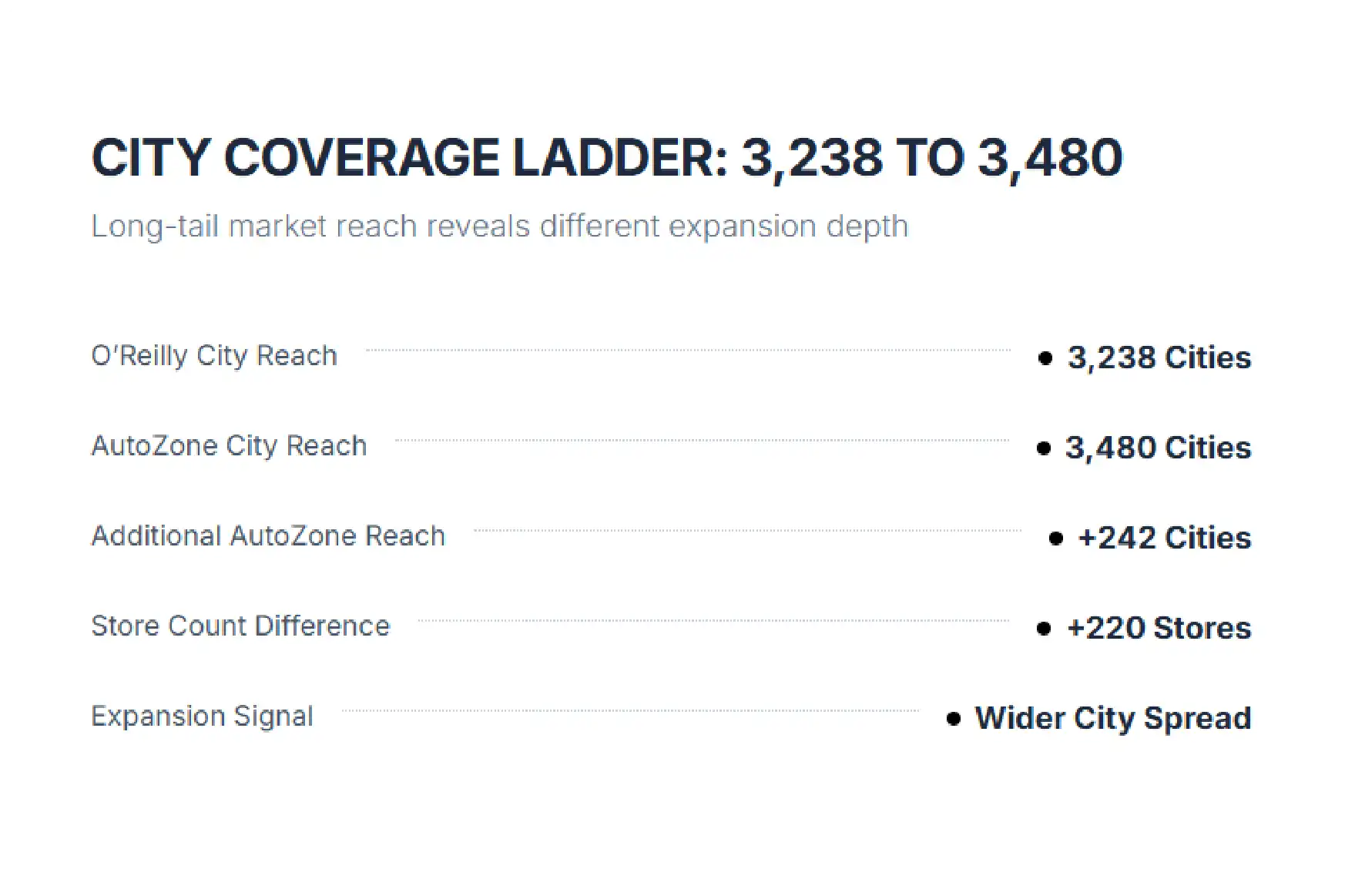
City coverage sharpens the contrast. AutoZone reaches 3,480 cities to O’Reilly’s 3,238 — more than 200 additional cities. Paired with its wider state footprint, that tells a consistent story: AutoZone is pushing into smaller and mid-sized markets that a more selective rival might pass over.
Reaching 200-plus more cities with only about 220 more stores is itself revealing: AutoZone is spreading its locations across a wider set of towns rather than stacking several stores into the same dense metros. That long-tail coverage builds broad national visibility, but also stretches each market thinner — a trade-off only visible when location data is analyzed city by city instead of as a national total.
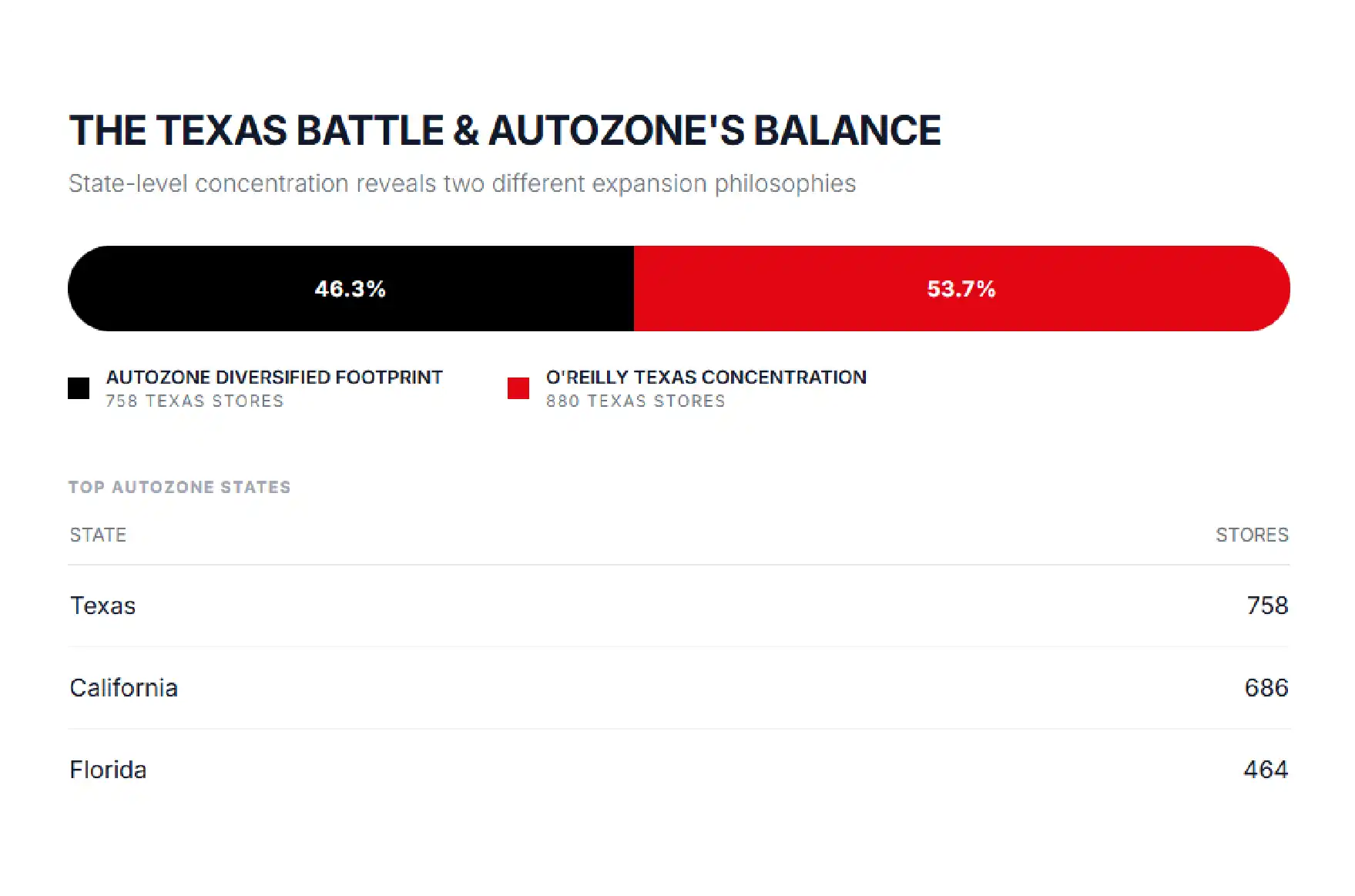
Zoom into a single state and the strategies collide. Texas is one of the biggest automotive markets in the country, and it is clearly O’Reilly’s stronghold: O’Reilly runs 880 Texas locations to AutoZone’s 758. O’Reilly is heavily concentrated in the market that matters most to it.
AutoZone, by contrast, spreads its strength across several large states rather than betting on one. Its top states show a more balanced distribution, which reduces dependence on any single market.
| Top AutoZone States | Stores |
|---|---|
| Texas | 758 |
| California | 686 |
| Florida | 464 |
The read is clear: O’Reilly goes deep where it is strongest, while AutoZone diversifies across multiple high-population states. Each approach carries a different risk profile, and only a state-by-state view reveals it.
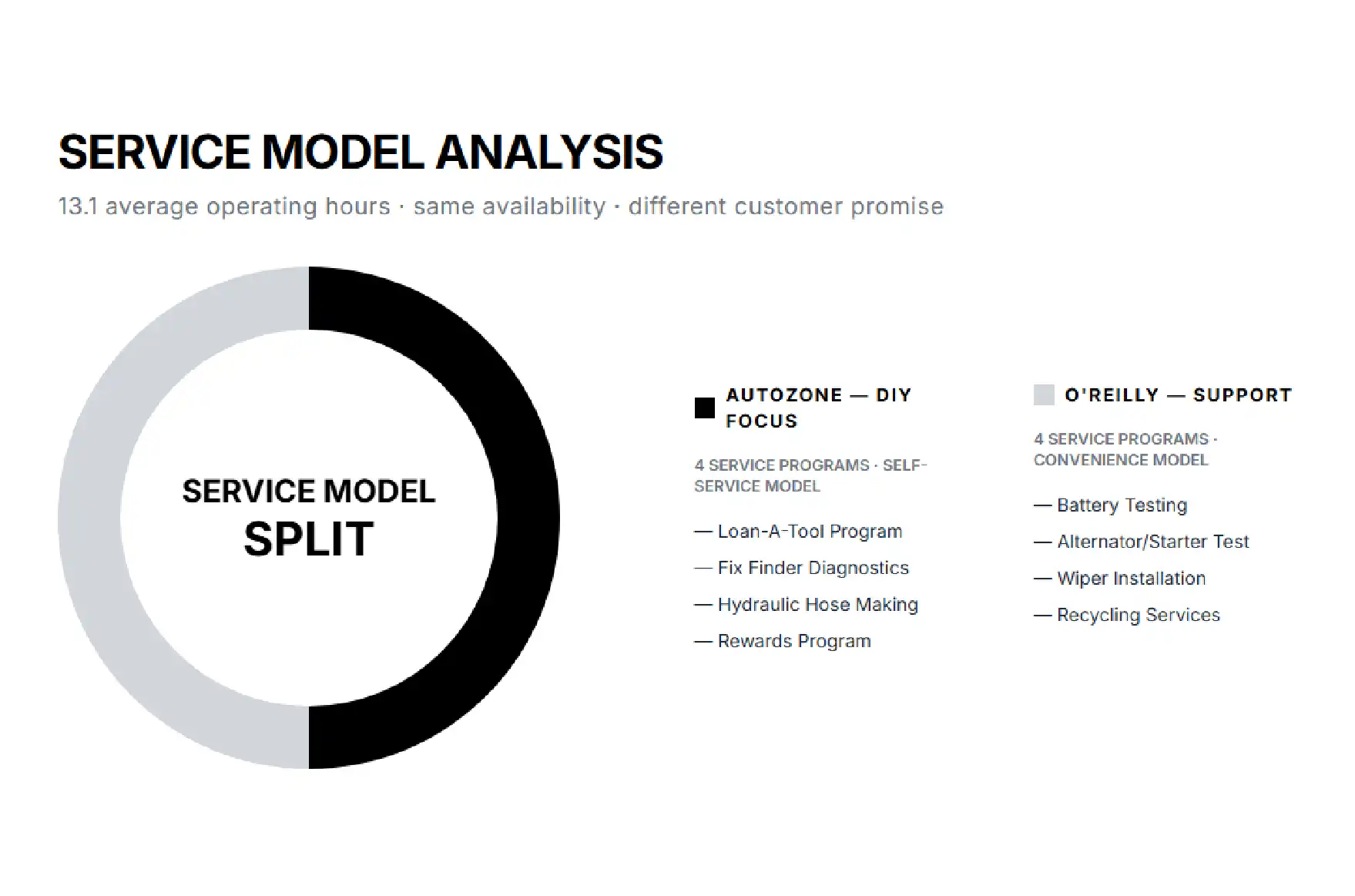
On operating hours the two are almost indistinguishable: AutoZone averages 13.14 hours a day, O’Reilly 13.11. Both understand that car problems do not follow business hours. But the services inside those hours point in opposite directions.
| AutoZone — DIY Focus | O’Reilly — In-Store Support |
|---|---|
| Loan-A-Tool program | Battery testing |
| Fix Finder diagnostics | Alternator & starter testing |
| Hydraulic hose making | Wiper & headlight installation |
| Rewards program | Recycling services |
AutoZone is built for customers who want to fix problems themselves — lending tools, helping diagnose, and rewarding repeat buyers. O’Reilly leans toward hands-on convenience, doing more for the customer in the store. Same shelf space, same hours, two very different promises about who walks in.
THE COMPETITIVE REALITY
Store count alone tells you almost nothing about who you are really up against. Two chains can match on size and still serve different customers in different places. The truth lives in the geocoded, service-level detail — not the headline total.
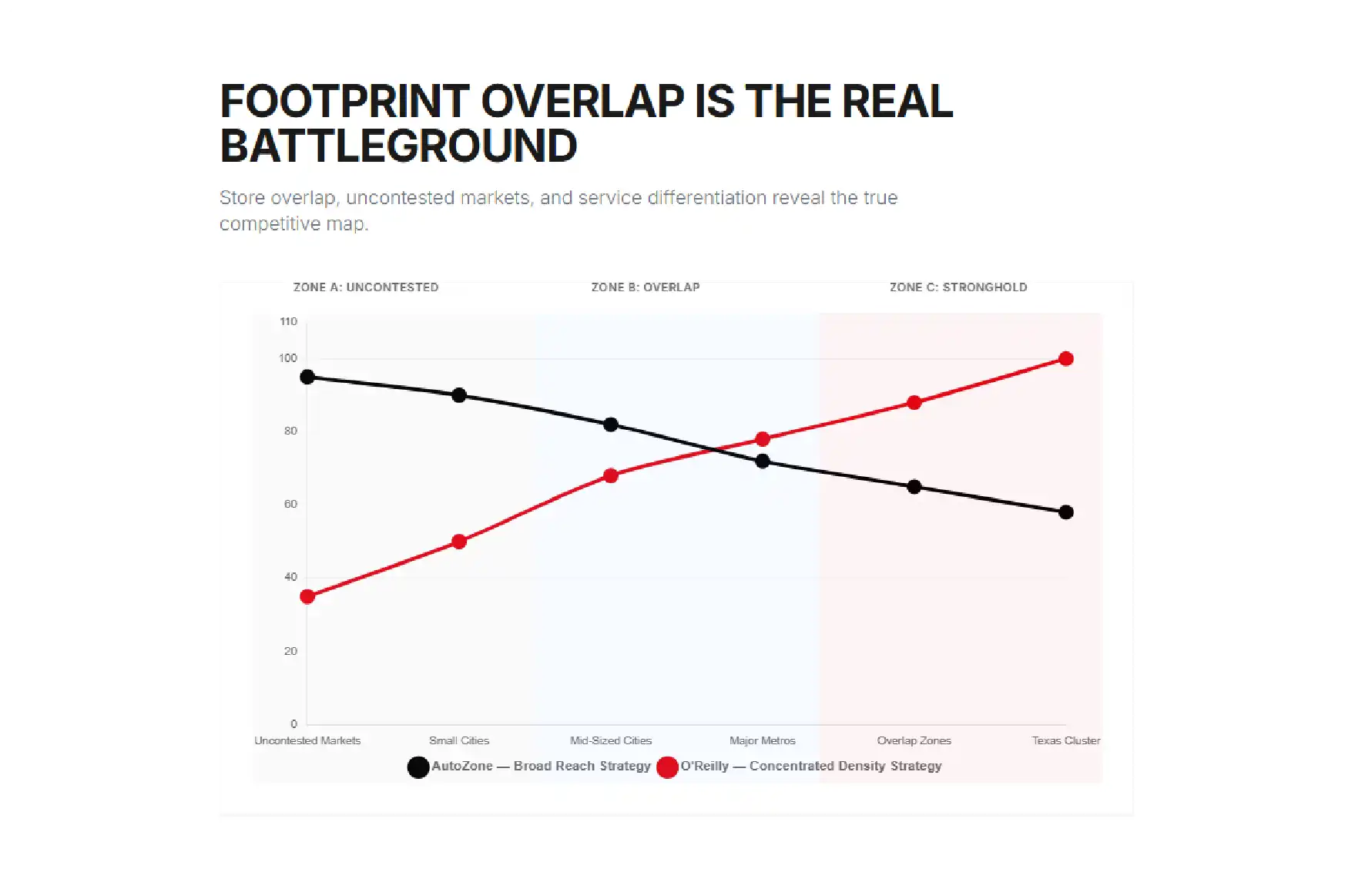
Here is the angle the surface-level comparison never reaches. Everyone counts stores; almost no one maps overlap. A near-identical national total of 6,720 versus 6,500 says nothing about where the two chains actually meet on the same corner versus where each operates with no rival in sight. That distinction is the real competitive map, and it only appears once both networks are geocoded and laid over each other.
Read this way, AutoZone’s 200-plus extra cities are not just broader reach — many are likely uncontested markets where it faces no O’Reilly store at all, a very different advantage than winning a crowded metro. O’Reilly’s Texas concentration, meanwhile, means the fiercest head-to-head density sits in one state. A national average blurs both facts; a ZIP-level overlap analysis makes them measurable.
The service split sharpens the point. Even where an AutoZone and an O’Reilly sit on the same street, the DIY-versus-in-store divide means they may court different shoppers — the weekend mechanic versus the driver who wants help at the counter. Proximity is not the same as direct competition. The lesson for any retail network is that footprint strategy lives in the overlap and the service mix, not the headline count — visible only when every store, coordinate, and service is captured as one connected map.
Below is a representative slice of the geocoded location dataset behind this report — the kind of clean, comparable rows our pipeline delivers for an entire store network.
| Store ID | Brand | City | State | Daily Hours | Lead Service |
|---|---|---|---|---|---|
| AZ-00214 | AutoZone | Houston | TX | 13.5 | Loan-A-Tool |
| OR-01188 | O’Reilly | Houston | TX | 13.0 | Battery testing |
| AZ-03391 | AutoZone | Los Angeles | CA | 13.0 | Fix Finder |
| OR-02077 | O’Reilly | Springfield | MO | 13.2 | Alternator testing |
| AZ-04510 | AutoZone | Miami | FL | 13.0 | Rewards program |
| OR-03642 | O’Reilly | Dallas | TX | 13.1 | Wiper installation |
| AZ-05883 | AutoZone | Tulsa | OK | 13.5 | Hydraulic hoses |
Store IDs shown are illustrative placeholders; values reflect the structure and scale captured during analysis.
The point of an analysis like this is the moves it makes possible. The six findings translate directly into actions a retailer or analyst can take this quarter.
None of these require insider information — only the discipline to collect public signals cleanly and read them honestly.
We exist to remove the hardest part of this work: the pipeline. iWeb Data Scraping handles the collection, cleaning, and structure so our clients do not maintain scrapers, fight CAPTCHAs, or wonder whether a blank field is a real gap or a silent failure. They receive clean, validated, decision-ready data on a schedule that fits their planning cycle.
That means addresses normalized and geocoded so networks compare like-for-like, hours parsed into usable numbers, and duplicate or closed stores removed so totals reflect live locations only. Whether you need a one-time competitive teardown like this one or continuous coverage across an entire category, the infrastructure headache is ours, and the insights are yours.
Want to see what this looks like for your category? We will pull a structured, geocoded location dataset at no cost.
Email info@iwebdatascraping.com with the subject line “Sample Dataset” and tell us the brand or category to analyze.
Start a projectCollecting publicly available store information — addresses, hours, and advertised services — is a widely used practice for market and competitive research. We focus only on public data, follow responsible collection practices, and never touch private information. We are happy to discuss your specific use case.
As fresh as you need it. Store networks change as locations open and close, so we schedule collection at the cadence that fits your decisions and timestamp every record so you know exactly when it was captured.
Yes. Every location is normalized and geocoded to real coordinates, which is what makes state-, city-, and ZIP-level comparison and overlap analysis possible rather than just a raw count.
Yes. The same approach applies to product catalogs, prices, reviews, and other public data across most major retailers and marketplaces. If your question spans several sources, we can give you one unified dataset.
Clean, structured files ready for analysis — typically spreadsheets or a feed into your existing tools, built so an analyst can use it immediately.
It depends on the number of locations, refresh frequency, and brands involved. We scope each engagement to your needs, with predictable pricing and no hidden engineering hours. Reach out for a quote.
We start by signing a Non-Disclosure Agreement (NDA) to protect your ideas.
Our team will analyze your needs to understand what you want.
You'll get a clear and detailed project outline showing how we'll work together.
We'll take care of the project, allowing you to focus on growing your business.