
52.4K+
TOTAL PRICE RECORDS PROCESSED ACROSS RETAILERS
Grocery Price-Trend Audit reveals 318,950 price changes across Walmart, Amazon, Kroger, Target & Instacart in 2026 analysis.
This case study is based on a real-world enterprise scenario where a grocery retail intelligence and analytics team leveraged large-scale multi-retailer data extraction through advanced systems to Scrape Grocery Price trend from Walmart, Amazon, Kroger, Target & Instacart, transforming fragmented pricing signals into structured competitive intelligence for pricing strategy, margin optimization, and real-time market monitoring.
It is designed for:
The client’s core challenge was simple: grocery pricing data across major retailers is highly dynamic, inconsistent in structure, and continuously updated through algorithmic pricing systems, making it difficult to consolidate into a single reliable intelligence layer.
This case study highlights how a comprehensive grocery pricing intelligence project analyzed over 318,950 price changes across major retailers including Walmart, Amazon, Kroger, Target, and Instacart. The objective was to understand real-time pricing behavior, competitive shifts, and promotional volatility across the U.S. grocery ecosystem. By tracking SKU-level movements, seasonal fluctuations, and algorithm-driven adjustments, the study revealed how often prices shift and which categories are most impacted. Insights helped the client identify pricing inefficiencies, competitor undercutting patterns, and high-frequency discount cycles that directly influence consumer buying behavior and margin performance.
The Grocery price trend audit enabled structured monitoring of retailer-wide pricing movements, ensuring consistent visibility into daily fluctuations across platforms.
Advanced modeling under Grocery price trend analysis 2026 uncovered emerging patterns in dynamic pricing and promotional timing strategies.
Using Amazon & Walmart grocery pricing analytics, the study compared aggressive pricing algorithms and revealed how both giants contribute significantly to rapid market-level price changes.
The client faced multiple operational and analytical challenges while attempting to build a unified grocery pricing intelligence system across major retailers. One of the key issues was inconsistent data structures and frequent schema changes across platforms, making it difficult to maintain reliable price tracking pipelines. Additionally, variations in promotional pricing and location-based discounts created discrepancies in comparison outputs, affecting accuracy and decision-making.
Another major challenge was ensuring continuous visibility into competitor movements, especially for Kroger & Target grocery price tracking, where pricing updates were highly dynamic and time-sensitive, requiring near real-time refresh cycles.
The complexity increased further with Instacart grocery price intelligence, as delivery fees, service charges, and partner store variations distorted pure product-level comparisons.
The client also struggled with building a standardized framework to Compare grocery prices across retailers, due to differing catalog formats and inconsistent SKU mapping across platforms.
To address these issues, scalable Web Scraping API Services were implemented, enabling structured, automated, and real-time data extraction across all grocery sources.
By implementing a system to Scrape Grocery Price trend from Walmart, Amazon, Kroger, Target & Instacart, the client replaced manual price observation with an automated grocery intelligence pipeline capable of continuously capturing SKU-level pricing changes, stock variations, and promotional movements across multiple retailers in real time.
| Dimension | Manual Grocery Tracking Approach | Automated Pricing Intelligence System |
|---|---|---|
| Data collection method | Manual browsing of selected product pages | Automated large-scale ingestion across multiple grocery platforms |
| Update frequency | Weekly or irregular checks | Near real-time updates with continuous refresh cycles |
| Pricing accuracy | Prone to missed updates and human error | High-precision extraction with validated price fields |
| Data organization | Unstructured notes and separate spreadsheets | Unified schema with standardized product attributes |
| Cross-retailer comparison | Difficult and time-consuming | Instant normalized comparison across all retailers |
| Promotion detection | Limited visibility into short-term deals | Full tracking of flash discounts and dynamic offers |
| Scalability | Restricted to small product sets | Scales to thousands of SKUs across categories |
The brand in focus is a data-driven retail analytics organization operating in the competitive grocery intelligence space, focused on tracking pricing behavior and promotional strategies across major online and offline grocery ecosystems.
As the business expanded, it faced challenges due to rapidly changing prices, inconsistent product listings, and fragmented retailer systems that made manual monitoring unreliable and slow. This created gaps in visibility, especially during high-frequency discount cycles and algorithm-driven price updates.
To solve this, the organization implemented an automated grocery data pipeline designed to continuously capture, standardize, and analyze pricing data from multiple retailers at scale.
Operating in a highly volatile pricing environment, the brand now relies on real-time intelligence to track competitor pricing shifts, optimize product positioning, and identify revenue opportunities faster. This transformation has enabled a shift from reactive monitoring to proactive pricing strategy execution, significantly improving decision speed and market responsiveness.
The solution framework focused on building a unified, scalable grocery data pipeline capable of capturing real-time pricing, availability, and promotional changes across major retailers. We implemented structured extraction models, normalized SKU mappings, and automated refresh cycles to ensure consistent and accurate insights across all data sources. Advanced validation rules were also introduced to eliminate duplicate or inconsistent pricing entries, improving overall data reliability for analytics and decision-making.
A centralized data lake was designed to integrate multi-retailer feeds, enabling seamless comparison and historical tracking. This allowed the client to move from fragmented reporting to a fully synchronized pricing intelligence system. The Kroger Grocery Datasets were structured to provide deep historical pricing patterns for predictive analytics and demand forecasting.
The Walmart Grocery Datasets enabled granular tracking of dynamic pricing shifts across high-volume product categories.
The Instacart Grocery and Supermarket Data Extraction Services supported real-time extraction of delivery-based pricing variations and retailer-specific markup behavior.
The automated scraping pipeline enabled continuous monitoring of price fluctuations across Walmart, Amazon, Kroger, Target, and Instacart. By capturing SKU-level changes in real time, the system exposed how frequently prices shift within short time windows, revealing that many products experience multiple adjustments within a single day, especially in high-demand categories like dairy, beverages, and packaged goods. This helped the client understand that grocery pricing is far more dynamic than periodic manual tracking suggested.
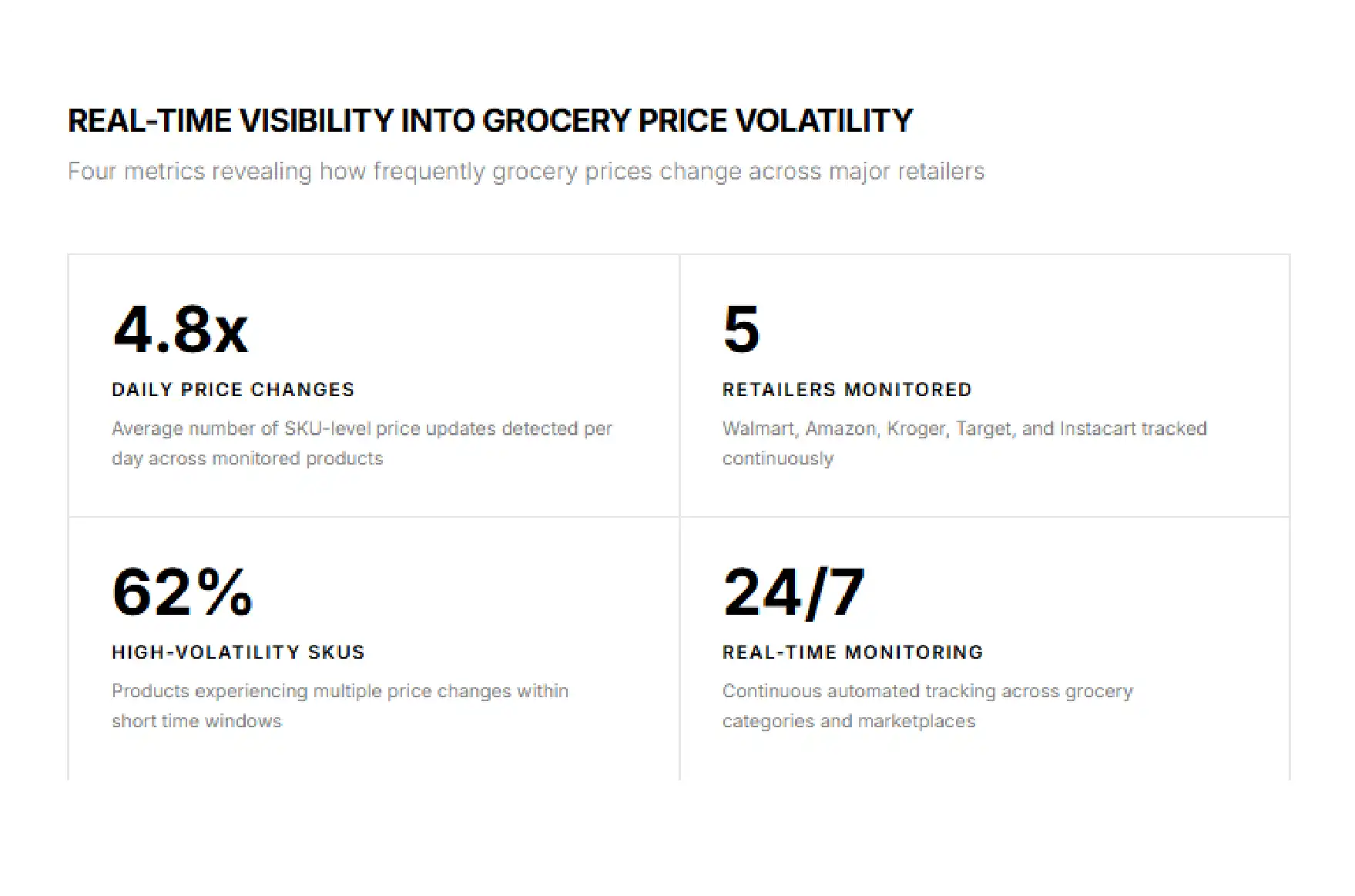
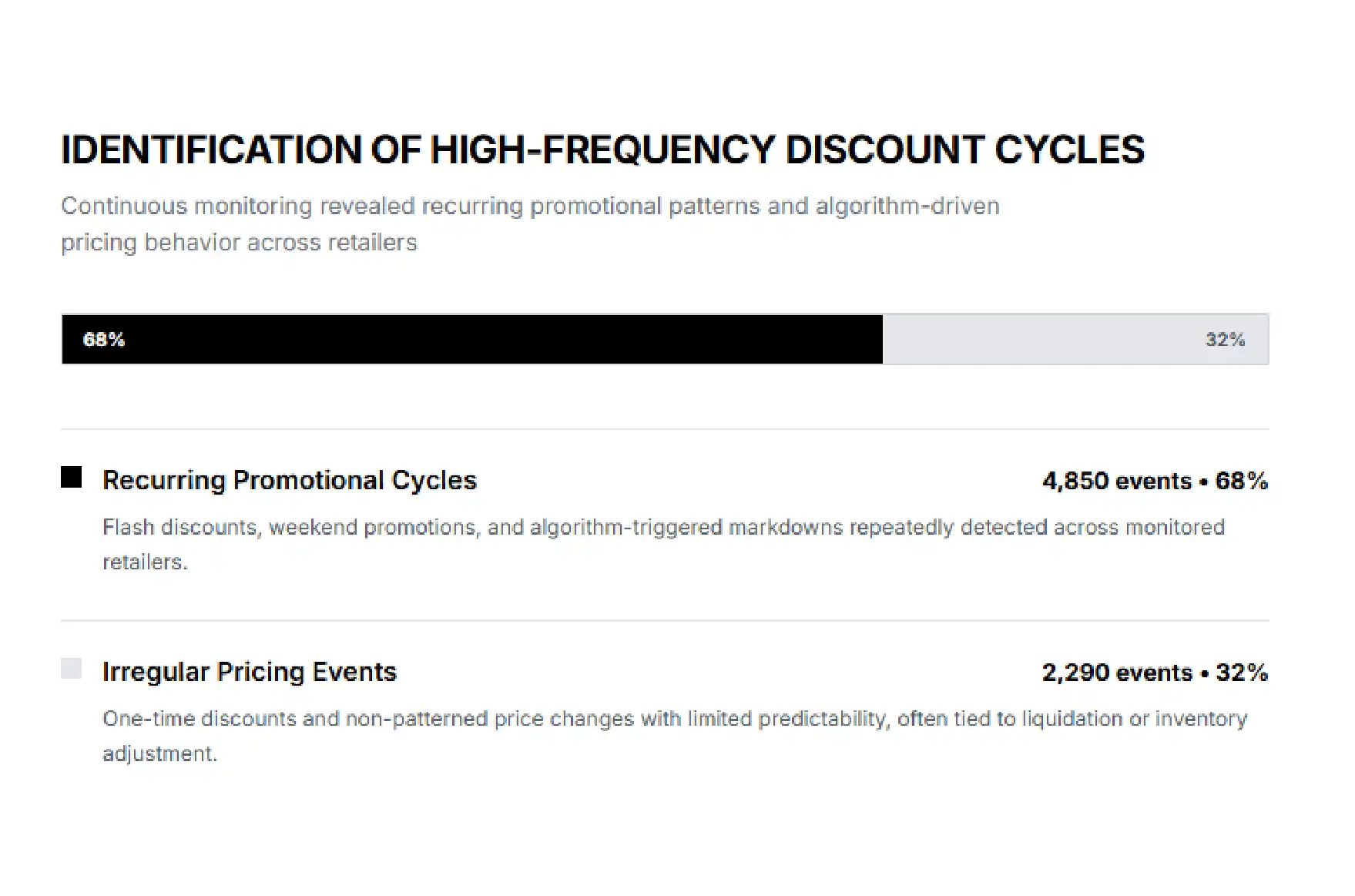
Through continuous analysis of promotional patterns and discount timestamps, the system uncovered recurring short-term pricing cycles across multiple retailers. These included flash discounts, weekend-driven promotions, and algorithm-triggered price drops. The pipeline highlighted that certain categories consistently undergo repeated discounting patterns, enabling the client to anticipate promotional windows and optimize competitive pricing strategies in advance.
MAP YOUR CATEGORY THIS CLEARLY
Picture this same store-by-store, city-by-city view for you and your top rivals. iWeb Data Scraping can deliver a clean, geocoded location dataset for any retail network in days. Email info@iwebdatascraping.com to scope it.
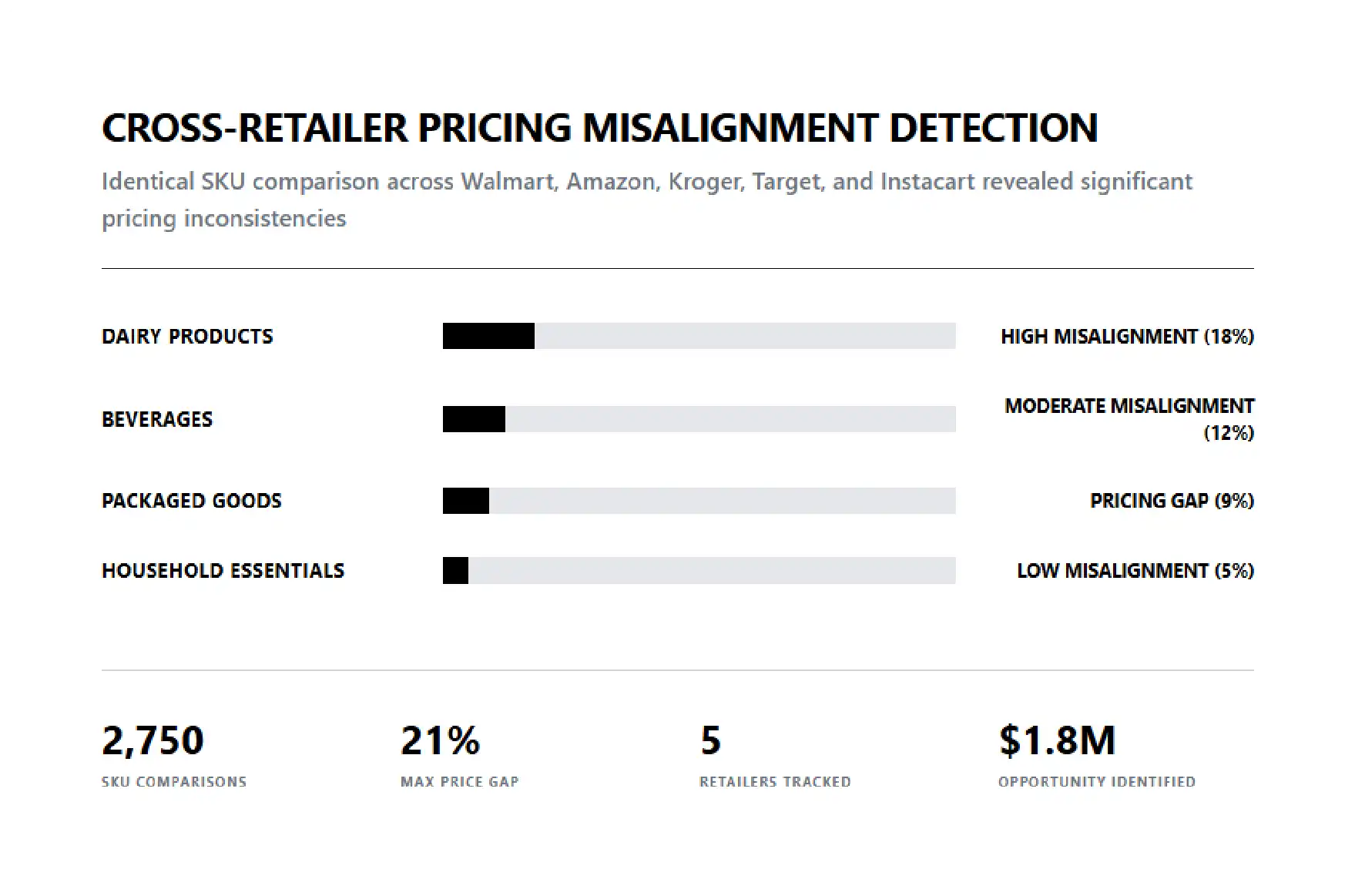
The structured dataset enabled direct comparison of identical SKUs across multiple grocery platforms, revealing frequent pricing inconsistencies between retailers. In several cases, the same product was found to be significantly cheaper on one platform due to localized promotions or delivery-based pricing strategies. This insight helped the client identify arbitrage opportunities and refine pricing benchmarks across their competitive landscape.
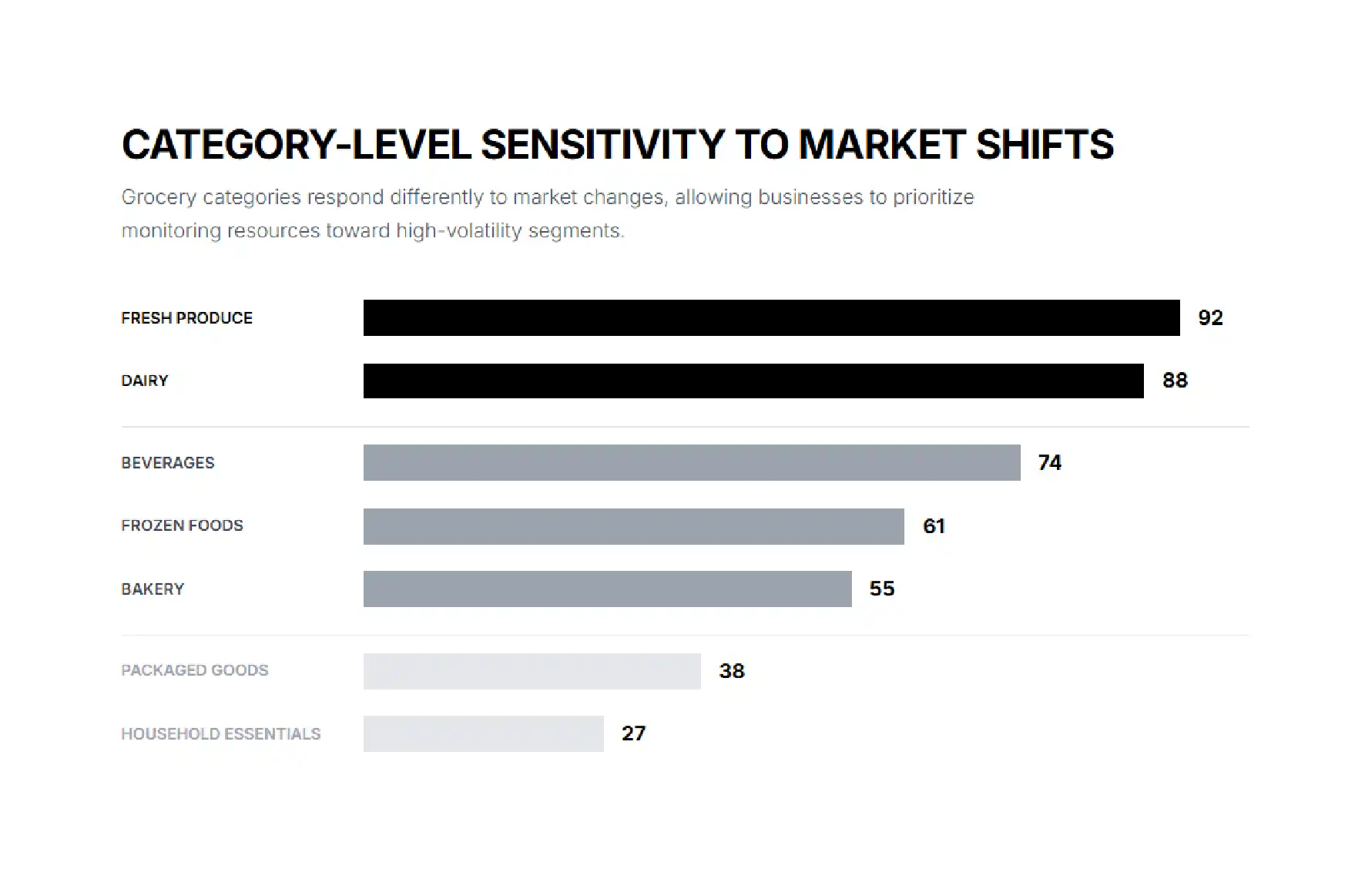
The analysis showed that not all grocery categories respond equally to market changes. Fresh produce and dairy exhibited high volatility with frequent price adjustments, while packaged and household goods remained relatively stable. This classification of category-level sensitivity allowed the client to prioritize monitoring efforts and allocate analytical resources more efficiently toward high-impact product segments.
This dataset highlights multi-retailer grocery pricing intelligence captured across leading platforms such as Walmart, Amazon, Kroger, Target, and Instacart. It showcases SKU-level price movements, discounts, availability status, and time-based updates to enable real-time competitive analysis and market monitoring.
| Retailer | Product Category | Price (USD) | Discount % | Availability | Timestamp |
|---|---|---|---|---|---|
| Walmart | Dairy Milk 1L | 2.45 | 5% | In Stock | 10:05 AM |
| Kroger | Bread Loaf | 1.89 | 10% | In Stock | 10:06 AM |
| Instacart | Organic Eggs 12 pcs | 4.20 | 7% | Limited | 10:07 AM |
| Target | Almond Milk 1L | 3.10 | 8% | In Stock | 10:08 AM |
| Amazon | Olive Oil 500ml | 5.99 | 12% | In Stock | 10:09 AM |
| Walmart | Chicken Breast 1kg | 7.85 | 6% | In Stock | 10:10 AM |
| Kroger | Butter 200g | 2.60 | 9% | In Stock | 10:11 AM |
| Instacart | Fresh Apples 1kg | 3.25 | 5% | Limited | 10:12 AM |
| Target | Whole Wheat Bread | 2.15 | 7% | In Stock | 10:13 AM |
| Amazon | Basmati Rice 5kg | 12.40 | 15% | In Stock | 10:14 AM |
| Walmart | Yogurt Pack 6 pcs | 4.10 | 4% | In Stock | 10:15 AM |
| Kroger | Cheese Slice 250g | 3.75 | 8% | In Stock | 10:16 AM |
| Instacart | Bananas 1kg | 1.95 | 6% | In Stock | 10:17 AM |
| Target | Orange Juice 1L | 3.60 | 10% | In Stock | 10:18 AM |
| Amazon | Peanut Butter 340g | 4.85 | 11% | In Stock | 10:19 AM |
Store IDs shown are illustrative placeholders; values reflect the structure and scale captured during analysis.
Following the deployment of a structured grocery intelligence system built on continuous multi-retailer data extraction, the client significantly improved its ability to monitor pricing behavior, detect market shifts, and respond to competitor actions across Walmart, Amazon, Kroger, Target, and Instacart in near real time.
Our data scraping services deliver continuous, real-time visibility into pricing changes, product availability, and competitor activity across multiple grocery retailers. This enables businesses to quickly identify market fluctuations, detect emerging trends, and make faster, data-driven decisions that improve profitability and strengthen competitive positioning across retail channels.
We ensure the delivery of clean, structured, and fully validated datasets extracted from diverse sources. By eliminating inconsistencies, duplicates, and errors, the data becomes reliable and analysis-ready, supporting accurate forecasting, effective pricing strategies, and streamlined operational planning without the need for manual correction or reconciliation.
Our solution is built for scalable multi-retailer integration, allowing large volumes of data to be extracted from multiple grocery and e-commerce platforms at the same time. Whether handling thousands or millions of records, the system maintains stability and efficiency while consolidating all inputs into a unified analytics ecosystem.
By automating data collection and processing workflows, we significantly reduce reporting delays and manual effort, enabling faster access to actionable insights. This helps businesses respond quickly to competitor pricing changes, optimize promotional strategies, and improve overall decision-making speed in dynamic retail environments.
We also provide enhanced competitive intelligence by tracking pricing patterns, promotional behavior, and product availability across the market. This continuous monitoring helps businesses anticipate shifts, refine strategies, and maintain a strong competitive edge through deeper visibility into evolving industry dynamics.
“Working with this team has significantly transformed the way we approach retail pricing intelligence. Their data scraping solution delivered highly accurate, real-time insights across multiple grocery platforms, helping us streamline our pricing strategy and improve market responsiveness. The structured datasets and consistent updates allowed our analytics team to identify trends faster and make more confident business decisions. The quality of support and technical execution exceeded our expectations, especially in handling large-scale multi-retailer data extraction. This partnership has added measurable value to our operations and strengthened our competitive positioning in a highly dynamic market environment.”
— Senior Data Analytics Manager
The final outcome of the project demonstrated a significant transformation in how the client accessed and utilized grocery market intelligence. With a centralized and automated data pipeline, the client achieved real-time visibility into pricing, promotions, and availability across multiple retailers, enabling faster and more accurate strategic decisions. The integration of structured datasets improved forecasting accuracy and reduced manual reporting efforts, leading to higher operational efficiency and cost savings. Additionally, the solution enhanced competitive benchmarking and allowed deeper insights into consumer pricing behavior across regions and platforms.
The deployment of Grocery and Supermarket Store Datasets enabled comprehensive historical and real-time analysis of retail pricing trends across categories.
Through Grocery & Supermarket Data Extraction Services, the client gained scalable access to multi-source data with improved accuracy and speed.
The use of Web Scraping Services ensured continuous, automated data collection, empowering the client with reliable, always-updated market intelligence for sustained competitive advantage.
By leveraging automated data scraping pipelines, businesses can continuously track pricing, availability, and competitor movements across multiple retailers to make faster, smarter, and more profitable decisions.
Start a projectOur services include real-time extraction of pricing, availability, discounts, product details, and promotional data from multiple grocery and supermarket platforms, delivered in structured formats for analytics and business intelligence use.
Data can be updated in real-time, hourly, or daily based on client requirements. We design flexible pipelines to ensure continuous monitoring of pricing changes and competitor activities across selected retailers.
Yes, our infrastructure supports large-scale multi-retailer scraping simultaneously, including platforms like Walmart, Amazon, Kroger, Target, and Instacart, ensuring unified and consistent data collection across sources.
Absolutely. We apply strict validation, deduplication, and normalization processes to ensure clean, structured, and analysis-ready datasets that can be directly used for dashboards, forecasting, and reporting.
Yes, we provide fully customizable scraping solutions. Clients can define specific data fields, categories, frequency, and formats based on their unique business and analytical needs.
We start by signing a Non-Disclosure Agreement (NDA) to protect your ideas.
Our team will analyze your needs to understand what you want.
You'll get a clear and detailed project outline showing how we'll work together.
We'll take care of the project, allowing you to focus on growing your business.