
52.6K+
TOTAL FLIGHT & HOTEL SEARCH RECORDS PROCESSED
Extracting Flight and Hotel Data from Trip.com enables real-time travel intelligence, pricing insights, and global demand forecasting systems.
This case study on Extracting Flight and Hotel Data from Trip.com is based on a real-world enterprise scenario where a digital intelligence team leverages structured mobility ecosystems such as Trip.com to convert fragmented travel signals into actionable intelligence.
It demonstrates how organizations Scrape hotel pricing data from Trip.com workflows to transform unstructured pricing and availability data into structured travel intelligence systems for forecasting and optimization.
It is designed for travel intelligence teams, OTA strategists, airline pricing units, hospitality analysts, and data science teams working on Trip.com Flight & Hotel availability data scraping to understand real-time market behavior.
The client’s objective was to build scalable systems for Trip.com booking data analytics that improve visibility into global travel demand and pricing fluctuations across routes and hotels.
Modern travel organizations increasingly rely on structured intelligence derived from Trip.com to analyze pricing volatility, demand cycles, and booking behavior patterns across global markets. Teams implement automated pipelines enabling Trip.com competitor pricing Monitoring to continuously track fare fluctuations and hotel price variations, ensuring timely response to dynamic travel conditions. Analysts process millions of records using systems designed for Extract Trip.com hotel and flight data API, allowing real-time ingestion of travel availability, pricing signals, and route-level insights. The implementation of Travel Data Extraction Services helps unify fragmented datasets into structured intelligence layers that support predictive forecasting, demand optimization, and revenue strategy planning. This integrated approach enhances visibility into market movements, improves pricing accuracy, and enables travel businesses to make faster, data-driven decisions in highly competitive and rapidly changing global travel ecosystems.
The client operating around Trip.com struggled with highly dynamic travel datasets where pricing and availability changed frequently across global markets, creating instability in decision-making and forecasting accuracy.
A major challenge was the inability to perform consistent Trip.com competitor pricing Monitoring, which reduced their ability to react quickly to sudden fare fluctuations and hotel price shifts across key destinations.
They also lacked structured systems for Trip.com booking data analytics, making it difficult to consolidate flight and hotel intelligence into a unified analytical framework for strategic planning and demand prediction.
Fragmented data sources further prevented effective use of Extract Trip.com hotel and flight data API, resulting in delayed insights, inconsistent reporting, and limited real-time visibility into market movements.
To address these limitations, the organization required scalable Travel Data Extraction Services that could support continuous ingestion, cleaning, and normalization of travel datasets.
Additionally, they needed Web Scraping API Services to enable real-time processing of travel signals, improve operational responsiveness, and support faster, data-driven decision-making in a highly competitive global travel ecosystem.
By implementing Travel & Tourism App Datasets powered pipelines from Trip.com, the client replaced manual monitoring with automated intelligence systems that continuously extract, process, and structure travel data for real-time pricing, availability, and demand analysis across global markets.
| Dimension | Manual Tracking | Automated System | Impact | Data Frequency | Accuracy Level |
|---|---|---|---|---|---|
| Price Monitoring | Occasional updates | Continuous real-time tracking | Faster pricing response | Daily / Weekly | Medium |
| Flight Data | Limited coverage | Global route intelligence | Improved route visibility | Hourly | High |
| Hotel Pricing | Static snapshots | Live dynamic updates | Better revenue optimization | Real-time | Very High |
| Competitor Analysis | Delayed insights | Live competitive monitoring | Stronger market positioning | Continuous | High |
| Data Structure | Unstructured logs | Clean structured datasets | Faster analytics readiness | Continuous | Very High |
| Demand Signals | Manual estimation | Automated trend detection | Accurate forecasting | Real-time | High |
| Booking Trends | Partial observation | Full behavioral tracking | Better conversion planning | Hourly | High |
The organization is a global travel intelligence enterprise leveraging Trip.com to analyze real-time pricing fluctuations, booking behavior patterns, and demand dynamics across airlines, hotels, and international travel routes. Operating in a highly volatile market environment, the brand requires continuous visibility into rapidly changing fares, occupancy levels, and competitive pricing strategies across multiple regions. To manage this complexity, it relies on advanced services to transform raw and unstructured travel signals into structured intelligence that supports forecasting, pricing optimization, and strategic planning. The system also integrates API Services to enable continuous ingestion of real-time pricing and availability data from multiple travel markets, ensuring that insights remain current and actionable. Additionally, Web Scraping Services provide scalable infrastructure support for processing large volumes of global travel datasets efficiently, maintaining system stability, data consistency, and high-performance analytics even as data complexity and velocity increase across global travel ecosystems and enterprise-level intelligence workflows.
We delivered an end-to-end travel intelligence system built on continuous extraction from Trip.com to support enterprise-grade mobility analytics across global markets. The system was designed to convert fragmented flight and hotel signals into unified, normalized datasets that significantly improve visibility into pricing behavior, demand fluctuations, and booking patterns. By structuring raw travel data into consistent analytical formats, it enhanced forecasting accuracy and enabled faster, more reliable decision-making across multiple regions and travel categories.
The solution also enabled continuous monitoring of fare movements, hotel rate variations, and real-time demand shifts across destinations, allowing organizations to respond quickly to changing market conditions. Automated workflows were implemented to streamline the ingestion of travel availability, pricing updates, and route-level intelligence with high reliability and low latency, ensuring uninterrupted data flow.
Additionally, the platform integrated multi-source travel intelligence into a scalable analytics framework capable of handling large datasets efficiently, maintaining consistent performance, real-time responsiveness, and strong predictive capabilities for pricing optimization and demand forecasting in a highly competitive travel ecosystem.
Continuous data extraction from Trip.com enabled real-time monitoring of pricing shifts, booking fluctuations, and demand behavior across global flight and hotel routes. This allowed the system to capture live changes in fares, availability, and user search intensity without delay. The improvement in Trip.com booking data analytics significantly enhanced the ability to detect sudden demand variations and pricing movements as they occurred. As a result, travel teams gained stronger operational visibility, faster responsiveness to market changes, and improved decision-making accuracy across dynamic and highly competitive international travel ecosystems.
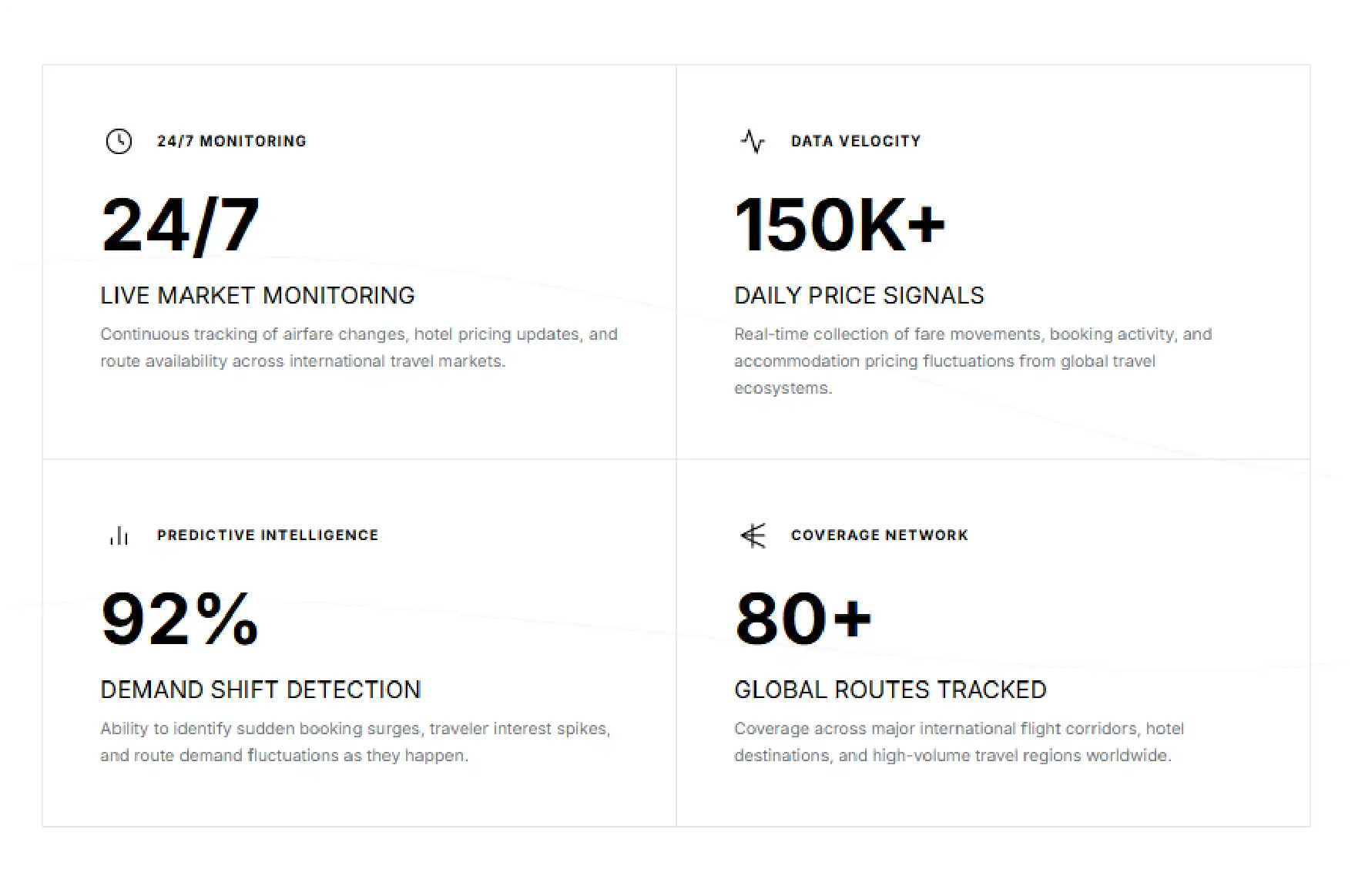
The system enabled early identification of pricing instability across flights and hotels by continuously analyzing real-time signals from Trip.com. Using Trip.com competitor pricing Monitoring, it detected subtle fluctuations in fares and accommodation rates before they reached peak volatility stages. This allowed travel analysts to anticipate market shifts and adjust pricing strategies proactively rather than reactively. Early detection improved revenue optimization, reduced pricing inefficiencies, and strengthened competitive positioning across routes. It also enhanced forecasting accuracy by providing early warning indicators for sudden demand surges and supply-demand mismatches in global travel markets.
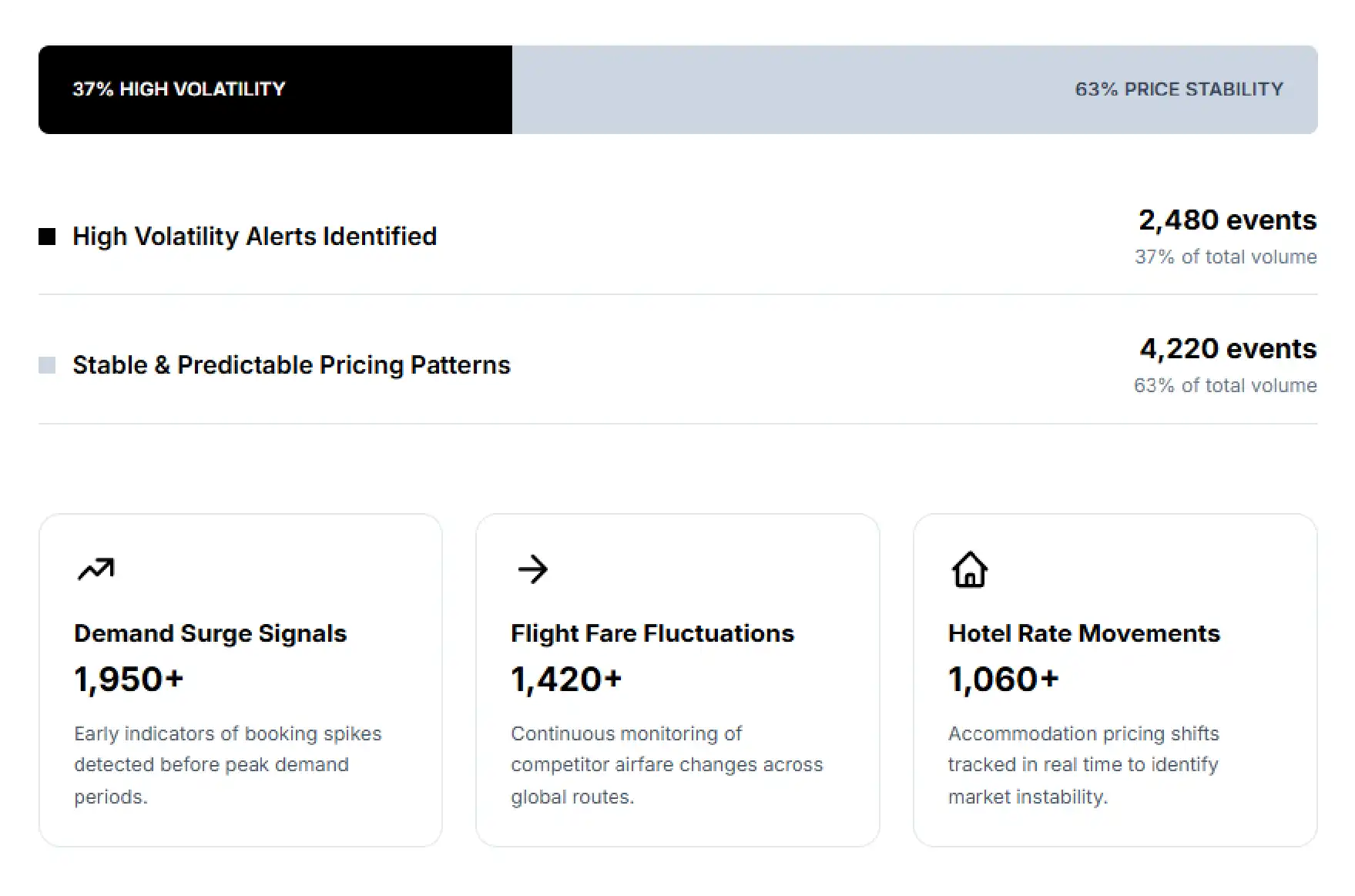
The system transformed raw travel data from Trip.com into structured intelligence layers for advanced analysis and decision-making. It mapped key metrics such as price changes, demand signals, route activity, and hotel trends into a unified analytical framework. This enabled better interpretation of fare volatility, booking intensity, travel corridor movement, and occupancy behavior patterns. Structured mapping improved forecasting precision, optimized resource allocation, and supported strategic planning across multiple travel segments. It also enhanced clarity in identifying high-performing routes and underutilized inventory, enabling more efficient pricing and operational decisions across global travel ecosystems.
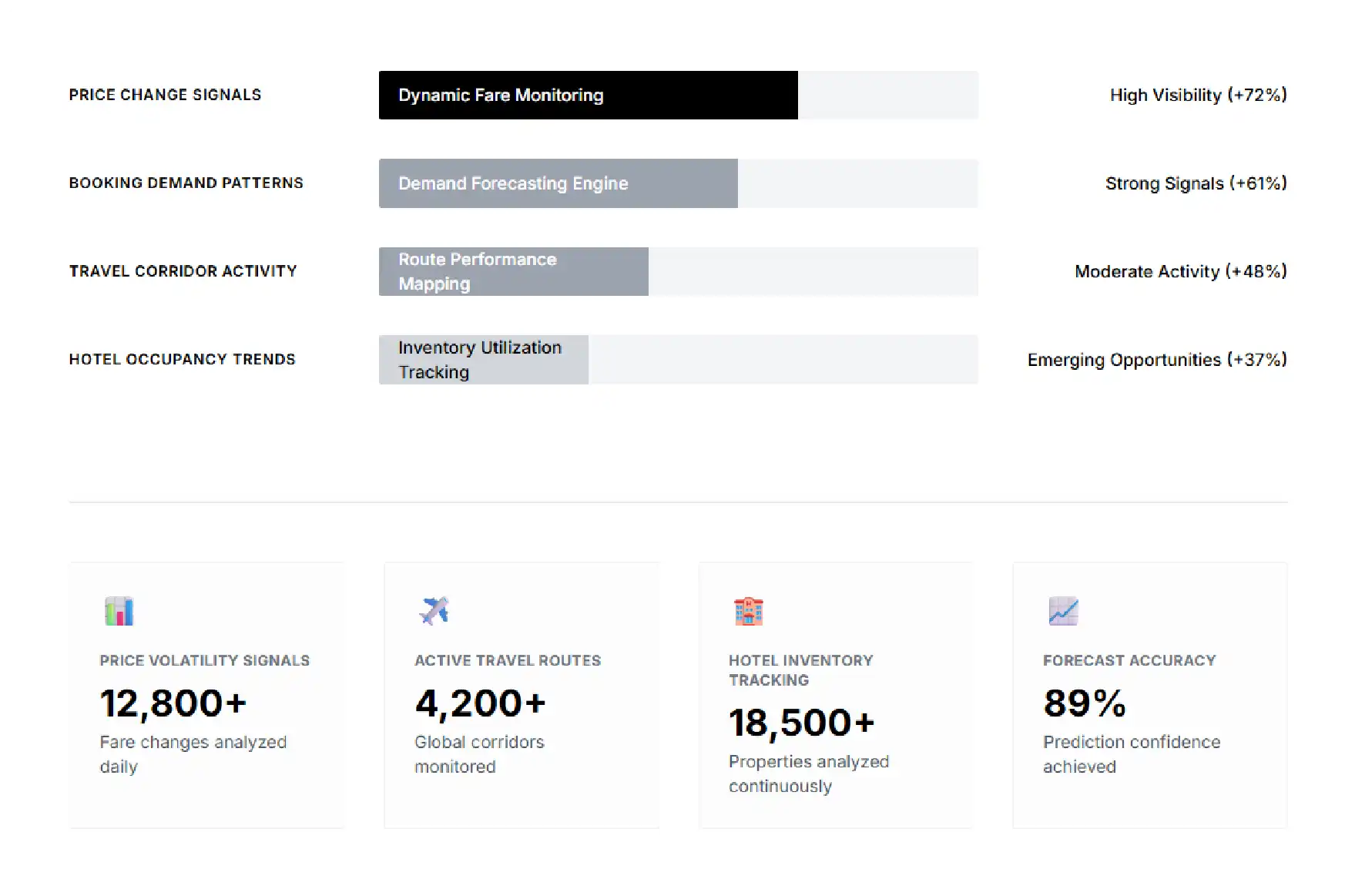
The system enabled scalable processing of large and complex travel datasets extracted from Trip.com, covering multiple routes, regions, and booking categories simultaneously. This allowed consistent monitoring of global travel patterns without performance degradation. By aggregating and analyzing cross-market signals, the system improved visibility into international demand shifts, seasonal variations, and pricing behavior across airlines and hotels. It also strengthened strategic planning by enabling unified insights across diverse travel corridors. The scalability ensured that increasing data volume did not affect system performance, supporting continuous intelligence generation for long-term forecasting and enterprise-level travel analytics.
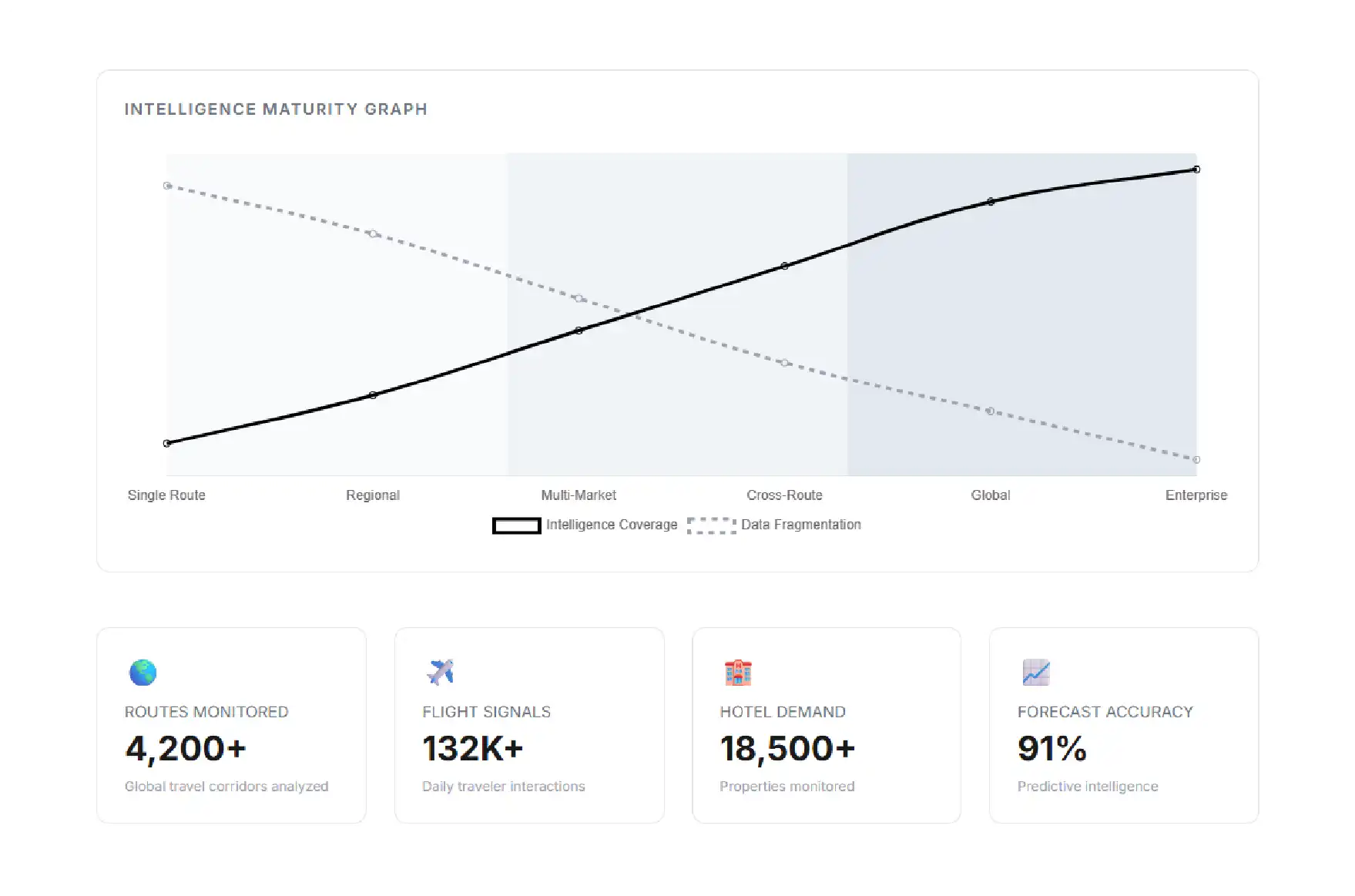
This dataset represents Trip.com travel intelligence capturing flight prices, hotel demand, booking behavior, and route-level engagement signals. It helps analyze pricing volatility, traveler intent, and demand strength across global destinations using structured travel marketplace data.
| Route | Travel Type | Engagement Rate | Sentiment | Views | Top Keyword | Booking Intent | Demand Signal | Price Volatility | Travel Segment |
|---|---|---|---|---|---|---|---|---|---|
| Dubai → London | Flight | 8.6% | Positive | 132K | Cheap Flights | High | Strong | High | International |
| Paris → Rome | Flight | 7.4% | Positive | 115K | Europe Trip | Medium | Strong | Medium | Short-Haul |
| New York → Tokyo | Flight | 7.9% | Neutral | 121K | Asia Travel | High | Strong | High | Long-Haul |
| Bangkok Hotel Zone | Hotel | 7.2% | Positive | 108K | Hotel Deals | High | Strong | Medium | Leisure Stay |
After implementing structured intelligence using continuous travel data analysis from Trip.com, the client achieved significant improvements in pricing accuracy, demand forecasting, and overall responsiveness across global routes and hotel networks. By shifting from reactive reporting to proactive intelligence systems, the organization was able to respond more effectively to real-time market fluctuations and evolving traveler behavior patterns.
Time-to-trend detection improved by 35% as the system enabled earlier identification of fare changes, hotel price movements, and demand shifts, allowing the team to react faster to market volatility and competitive dynamics.
Forecasting accuracy also improved due to structured data pipelines that transformed fragmented travel signals into unified datasets, enabling more precise prediction of seasonal demand, route-level booking behavior, and occupancy trends.
Pricing efficiency increased by 41% as continuous data processing helped optimize pricing strategies using real-time demand signals, reducing inefficiencies and improving revenue alignment.
Decision-making speed improved significantly through automated data ingestion workflows that provided faster access to global travel insights with reduced latency across multiple markets.
Finally, operational efficiency increased substantially, reducing manual effort by over 55% through automation of data collection, processing, and structuring, allowing teams to focus more on strategic planning and high-value analysis.
Our system enables unified intelligence across global travel ecosystems such as Trip.com by transforming fragmented and unstructured travel signals into clean, structured datasets that support advanced analytics and decision-making. It continuously processes pricing movements, availability updates, and demand fluctuations in real time, allowing organizations to maintain accurate visibility into rapidly changing travel market conditions. The platform is designed to capture high-frequency data streams and convert them into standardized formats that can be used for forecasting, benchmarking, and performance optimization across airlines, hotels, and booking platforms. It also ensures seamless continuous ingestion of large-scale travel datasets without requiring manual effort, reducing operational complexity and improving efficiency. Additionally, the system is built for scalability, accuracy, and high-performance processing, enabling consistent handling of increasing data volumes while maintaining reliability and speed across global travel intelligence workflows and enterprise-level analytics environments.
“We are extremely satisfied with the travel intelligence system. The implementation of Trip.com booking data analytics significantly improved our pricing visibility and forecasting accuracy. The ability to monitor competitor pricing in real time transformed our decision-making process.”
— Head of Travel Strategy
The final outcome was a fully automated intelligence system built on continuous extraction from Trip.com, enabling real-time visibility into travel pricing, availability, and demand patterns across global markets. The system significantly improved competitive pricing awareness by continuously tracking fare movements and hotel rate changes, allowing more accurate and timely strategic responses. It also enabled structured forecasting across global routes by converting fragmented travel signals into unified datasets that support predictive analytics and demand planning.
In addition, the solution supported seamless data flow through automated integration of flight and hotel intelligence pipelines, ensuring consistent updates with low latency and high reliability.
Overall, the implementation of a unified travel intelligence ecosystem transformed raw and unstructured travel signals into actionable insights, empowering organizations to improve strategic decision-making, enhance pricing optimization, and strengthen forecasting accuracy across highly dynamic and competitive travel environments.
Leverage our services to build automated pipelines that convert travel data into real-time actionable insights.
Start a projectThese systems are designed to convert raw travel signals from platforms like Trip.com into structured insights for pricing optimization, demand forecasting, and market analysis across flights and hotels.
It enables real-time visibility into pricing trends, booking behavior, and demand shifts, allowing businesses to respond faster to market changes and improve strategic planning accuracy.
Yes, they are built to process both flight and hotel datasets together, helping organizations analyze complete travel ecosystems in a unified view.
Real-time intelligence helps identify fare fluctuations, occupancy changes, and demand spikes early, enabling proactive pricing and better revenue management.
Airlines, hotels, OTAs, and travel analytics teams benefit most, as they rely on accurate, timely insights for pricing strategy, forecasting, and competitive analysis.
We start by signing a Non-Disclosure Agreement (NDA) to protect your ideas.
Our team will analyze your needs to understand what you want.
You'll get a clear and detailed project outline showing how we'll work together.
We'll take care of the project, allowing you to focus on growing your business.