
11K
TOTAL REVIEWS
eCommerce data extraction reveals how a focused skincare brand's 13 products, hero SKUs, and accessible pricing build trust and repeat buyers on Amazon.
Good eCommerce data extraction does more than count products and reviews — it exposes the strategy inside the numbers. We rebuilt a focused Amazon skincare brand's presence from public data to show what that discipline reveals. This teardown speaks to:
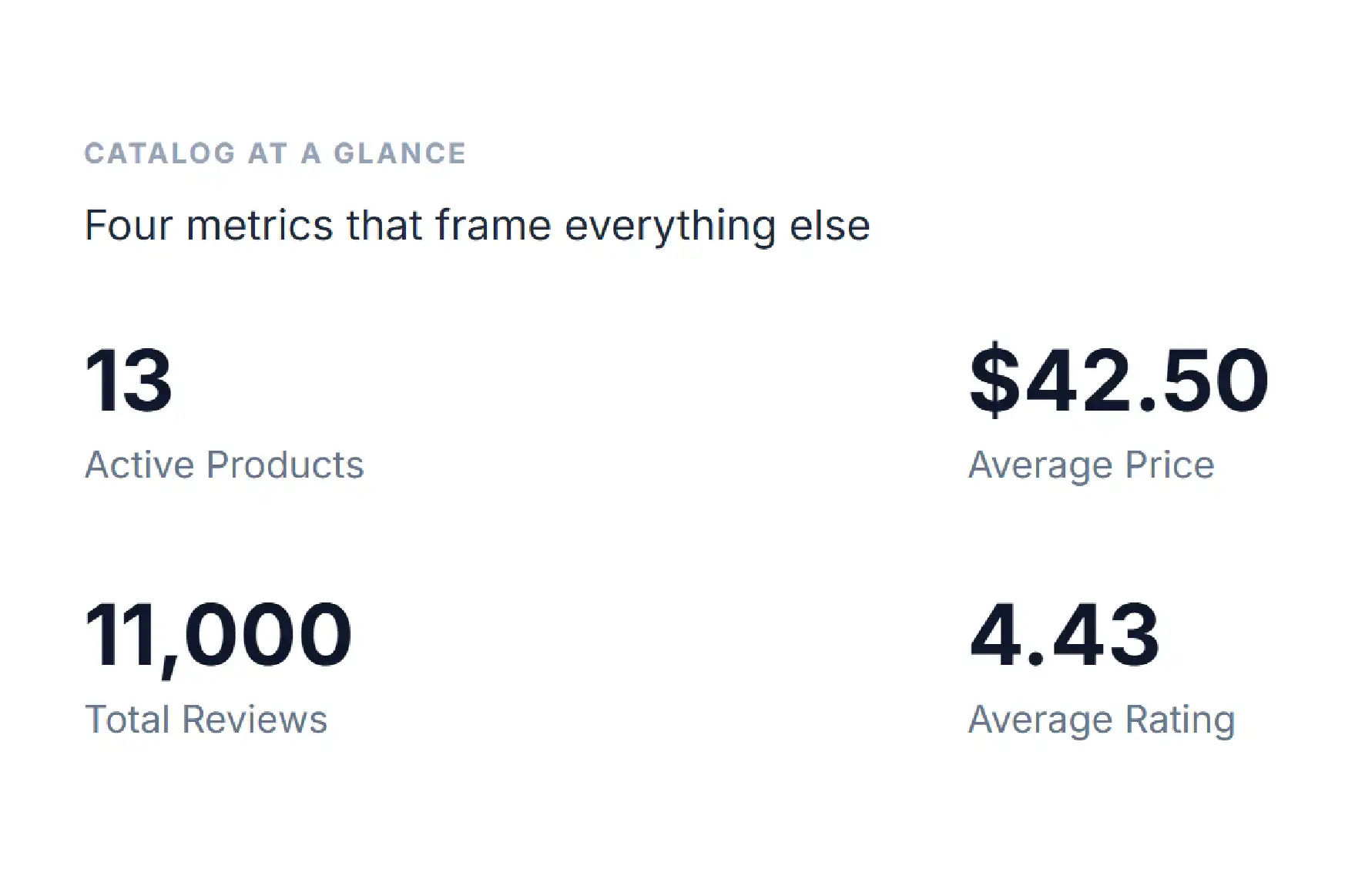
Hero Cosmetics proves that focus beats size on Amazon. The skincare brand built strong customer confidence on a deliberately small catalog: 13 products across 10 categories, roughly 11,000 reviews, a 4.43-star average, a $16.59 blended price, and just two sellers. It does not try to own the skincare aisle. It owns a short list of specific problems — acne, dark spots, pore care, sensitive skin — and earns trust in each.
Using eCommerce data extraction, we reconstructed that strategy from public listings: the hero SKUs carrying the review weight, the rating band that signals repeat buyers, and the accessible-but-not-cheap pricing. The pattern most analyses miss is structural — with 13 products across 10 categories, the catalog runs almost one product per category. Our unique read treats that as a search-intent map: each SKU is built to own a distinct, high-intent skincare query, so a tiny catalog punches far above its weight in discovery. This report covers six findings and what the same approach reveals about any brand you study.
Reading one product page is easy. Turning a brand's full Amazon presence into a clean, comparable dataset is not. Retailers defend against automated access with rate limits, rotating layouts, bot detection, and CAPTCHAs that break naive scrapers. Prices shift by the minute and vary by seller and coupon, so a single snapshot can be wrong within hours. The HTML changes constantly, so a selector that worked last week silently returns blanks this week. And Amazon pools reviews across size variations under a parent listing, which is easy to mis-handle. Reliable eCommerce data extraction is therefore less about writing a script and more about a resilient pipeline with a verification layer that turns raw pages into something trustworthy.
Here is how a do-it-yourself stack compares with a managed service across the dimensions that decide whether the data is usable.
| Dimension | DIY Scraping | iWeb Data Scraping |
|---|---|---|
| Setup time | Weeks of engineering before clean data | Live within days, scoped to your brand |
| Anti-bot handling | Constant firefighting with blocks and CAPTCHAs | Managed proxy and detection layer |
| Variation logic | Reviews miscounted across sizes | Parent-child mapping resolved explicitly |
| Data accuracy | Silent failures; blanks pass as real | Validated, deduplicated, QA-checked |
| Price freshness | Stale between manual runs | Refreshed at your chosen cadence |
| Maintenance | Breaks on every layout change | Pipeline upkeep included |
| Total cost | Hidden in engineering hours | Predictable, decision-ready deliverable |
Hero Cosmetics built its name solving specific skincare problems rather than selling a sprawling range. Its products target clear, searchable concerns — acne, blackheads, dark spots, sensitive skin — and that focus shows up directly in the ratings. Best known for its acne-patch heritage, the brand's Amazon presence spans sunscreens, cleansers, serums, retinol, and eye creams, each aimed at a distinct need.
The numbers reward that discipline: 13 products earning roughly 11,000 reviews at a 4.43 average is a trust-per-SKU ratio many larger catalogs never reach. Everything about the strategy is publicly observable — products, prices, reviews, and categories all sit in plain sight — so reading the data shows exactly how focus, not breadth, built the brand's standing.
We approached Hero Cosmetics' Amazon presence as a structured collection problem with a verification layer on top. We enumerated every live product, capturing ASIN, title, category, price, star rating, and review count, and resolved parent-child relationships so size and format variations were mapped correctly rather than double-counted.
Every record then passed through validation — empty fields re-fetched instead of accepted as zeros, outliers checked against the live page, duplicates collapsed. Only then did we analyze: review concentration, the rating band, the price ladder, category focus, and the search-intent mapping that closes this report.
The first signal is efficiency. Thirteen products have earned around 11,000 reviews at a 4.43-star average — a level many brands with several times the catalog never reach. The combination points to a confident, repeat-buying customer base rather than a one-time-curiosity crowd. In skincare, where trust is everything, that is the foundation the rest of the strategy is built on. The next finding shows where that trust is concentrated.
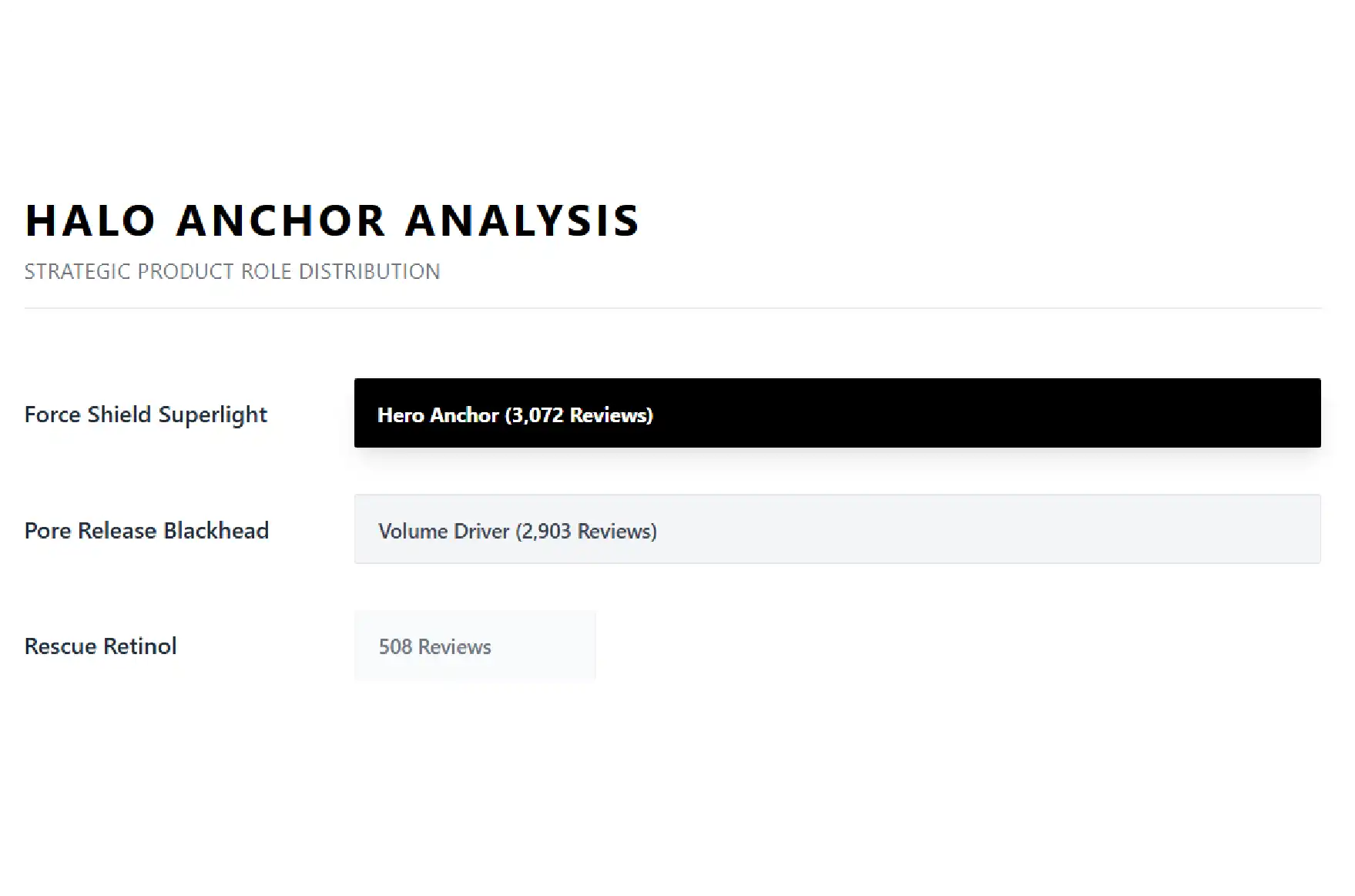
Rank the catalog by reviews and a clear hierarchy appears — a handful of products carry the bulk of the brand's social proof.
| Product | Concern | Reviews |
|---|---|---|
| Force Shield Superlight Sunscreen SPF 30 | Sun protection | 3,072 |
| Pore Release Blackhead Clearing Solution | Pore care | 2,903 |
| Rescue Retinol Nighttime Renewing Cream | Renewal / aging | 508 |
Two products alone account for nearly 6,000 reviews — more than half the brand's total. These hero SKUs do the heavy lifting: they win the search rankings, gather the reviews, and pull first-time buyers into the rest of the line. Knowing which products play that role tells a brand where to protect rankings, and tells a competitor exactly which listings define the category.
SEE YOUR OWN CATALOG THIS CLEARLY
Picture this same hero-SKU and rating view for your brand or a competitor. iWeb Data Scraping can deliver a clean, structured dataset for any category in days. Email info@iwebdatascraping.com to scope it.
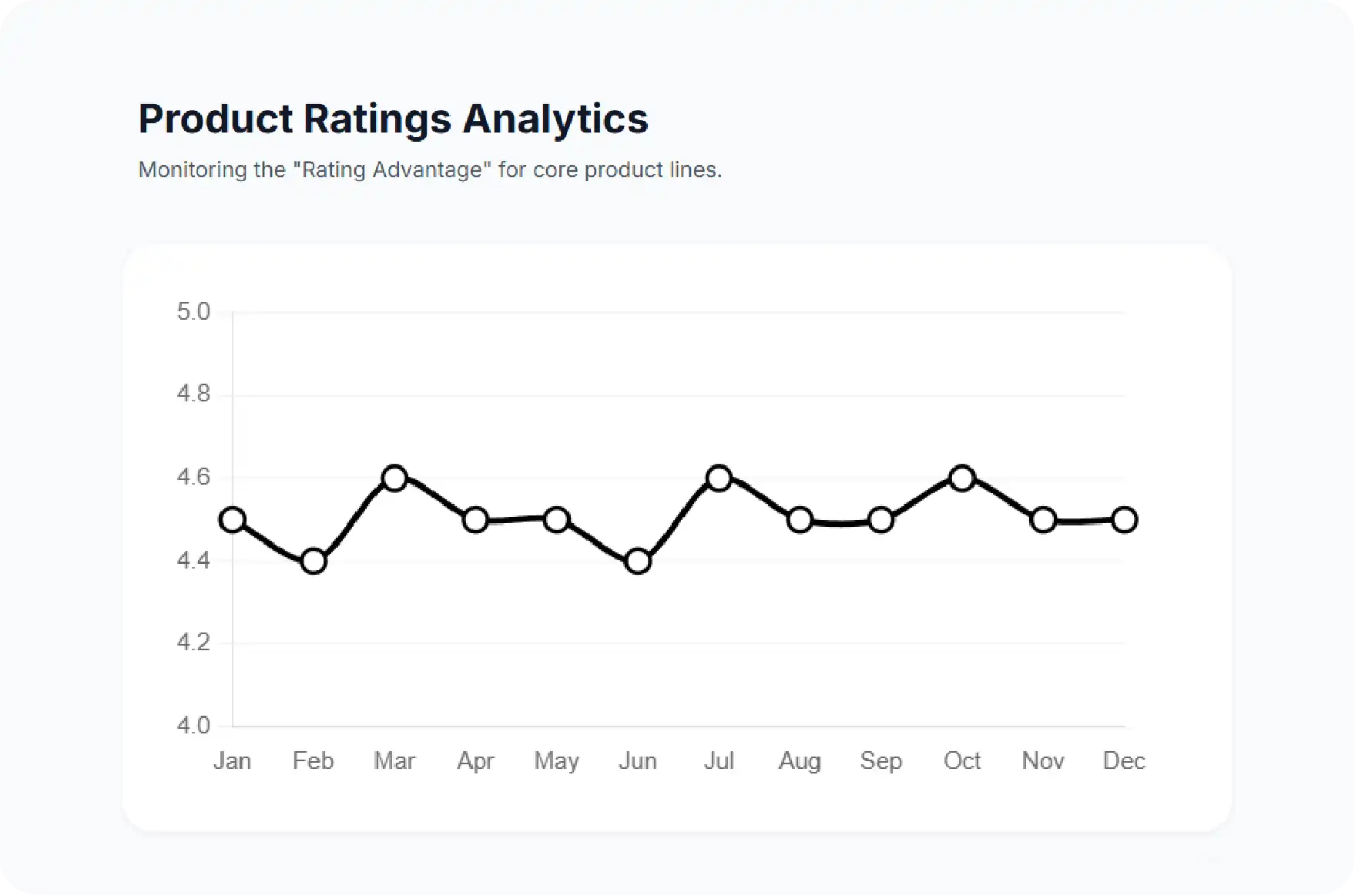
Most of Hero's top products sit between 4.4 and 4.6 stars — a tight, high band that matters more in skincare than in almost any other category. People do not keep rebuying a product that irritates their skin, so a consistently high rating is direct evidence of repeat purchase, not just first-time satisfaction.
That makes the rating column a leading indicator worth watching: a product slipping from 4.5 toward 4.0 is an early warning of a formulation or fulfillment problem long before it shows up in sales. For Hero, the steadiness of the band is quiet proof that the focus on targeted, well-formulated products is working — consistent ratings are what turn a trial into a habit.
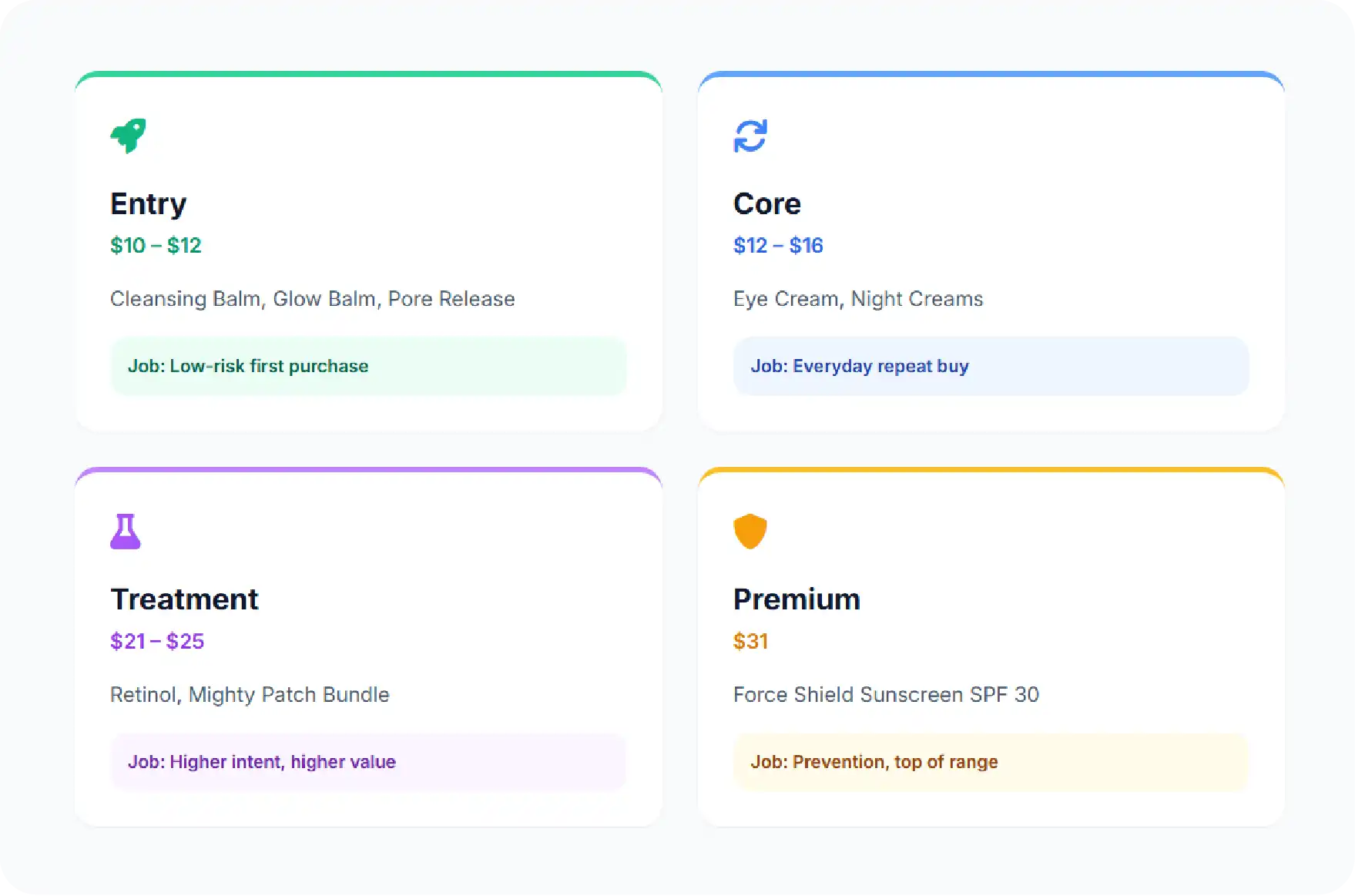
Hero's $16.59 average sits in a deliberate middle ground: affordable enough for an impulse buy, premium enough to avoid looking cheap. That balance works well in skincare, where too low reads as ineffective and too high reads as inaccessible. The catalog spreads cleanly from low-risk entry products to higher-priced treatment items.
| Tier | Example Products | Price | Job |
|---|---|---|---|
| Entry | Cleansing Balm, Glow Balm, Pore Release | $10 – $12 | Low-risk first purchase |
| Core | Eye Cream, Night Creams | $12 – $16 | Everyday repeat buy |
| Treatment | Retinol, Mighty Patch Bundle | $21 – $25 | Higher intent, higher value |
| Premium | Force Shield Sunscreen SPF 30 | $31 | Prevention, top of range |
The pattern is intentional: easy entry pricing helps first-time buyers try the brand, while customers willingly pay more for prevention and treatment. The $31 sunscreen and $25 patch bundle prove there is real headroom at the top, but the bulk of the line stays in the accessible middle that defines the brand.
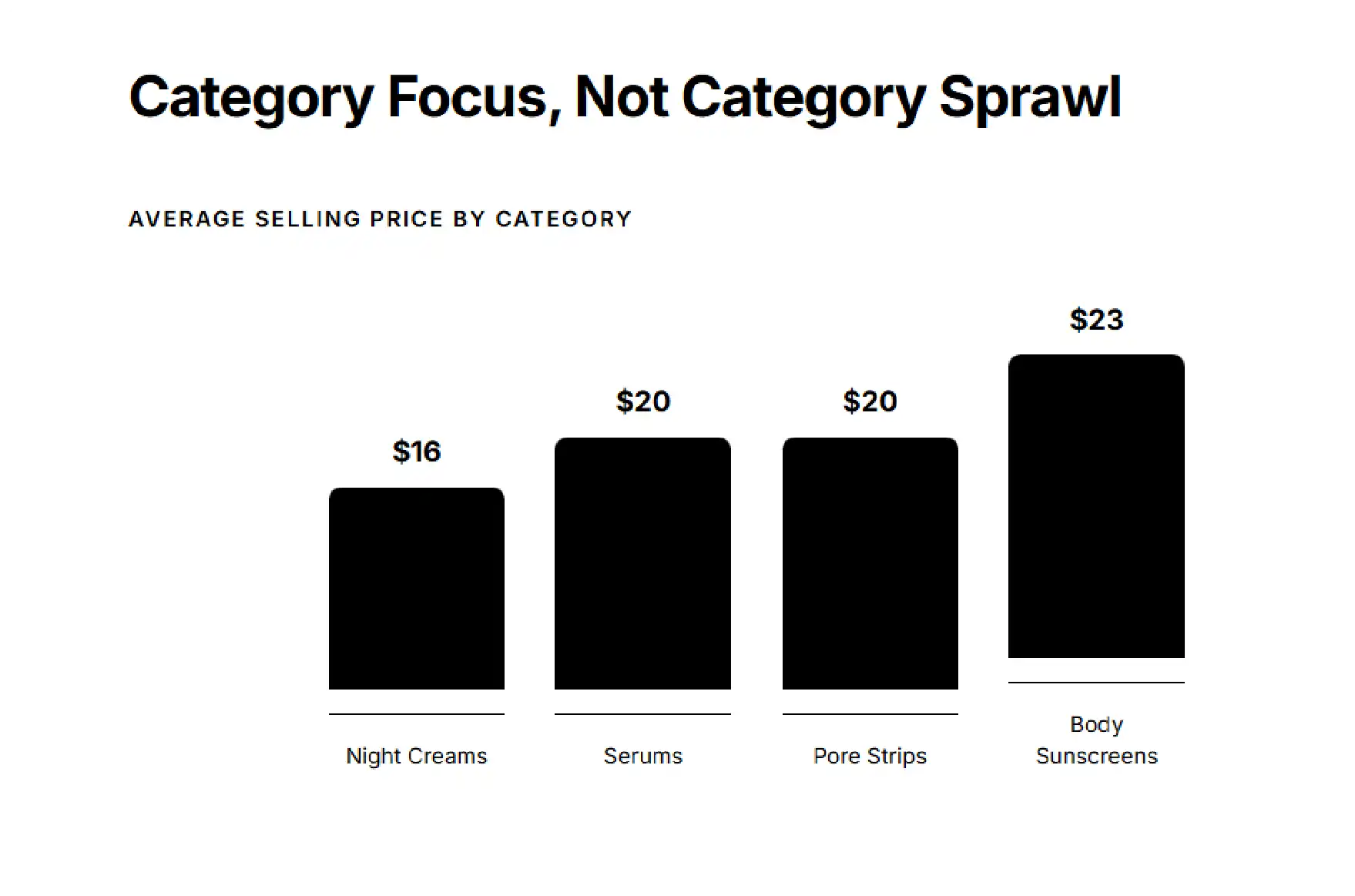
Hero concentrates its catalog where specific problems live. Each category solves a defined skincare concern, and average prices vary by how much intent each concern carries.
| Category | Avg Price | Concern Solved |
|---|---|---|
| Body Sunscreens | $23 | Prevention / protection |
| Pore Cleansing Strips | $20 | Pore care |
| Serums | $20 | Targeted treatment |
| Night Creams | $16 | Overnight renewal |
The higher-priced categories are the treatment and prevention ones, where shoppers arrive with clear intent and a willingness to pay; the everyday categories stay accessible. This is concentration by design — the brand goes deep on a short list of concerns instead of thin across many.
THE COMPETITIVE REALITY
A brand's real strategy is rarely on one product page — it is spread across products, prices, and categories. Pull only what is in front of you and you will misread the whole picture. The structure is visible only when the full catalog is captured cleanly.
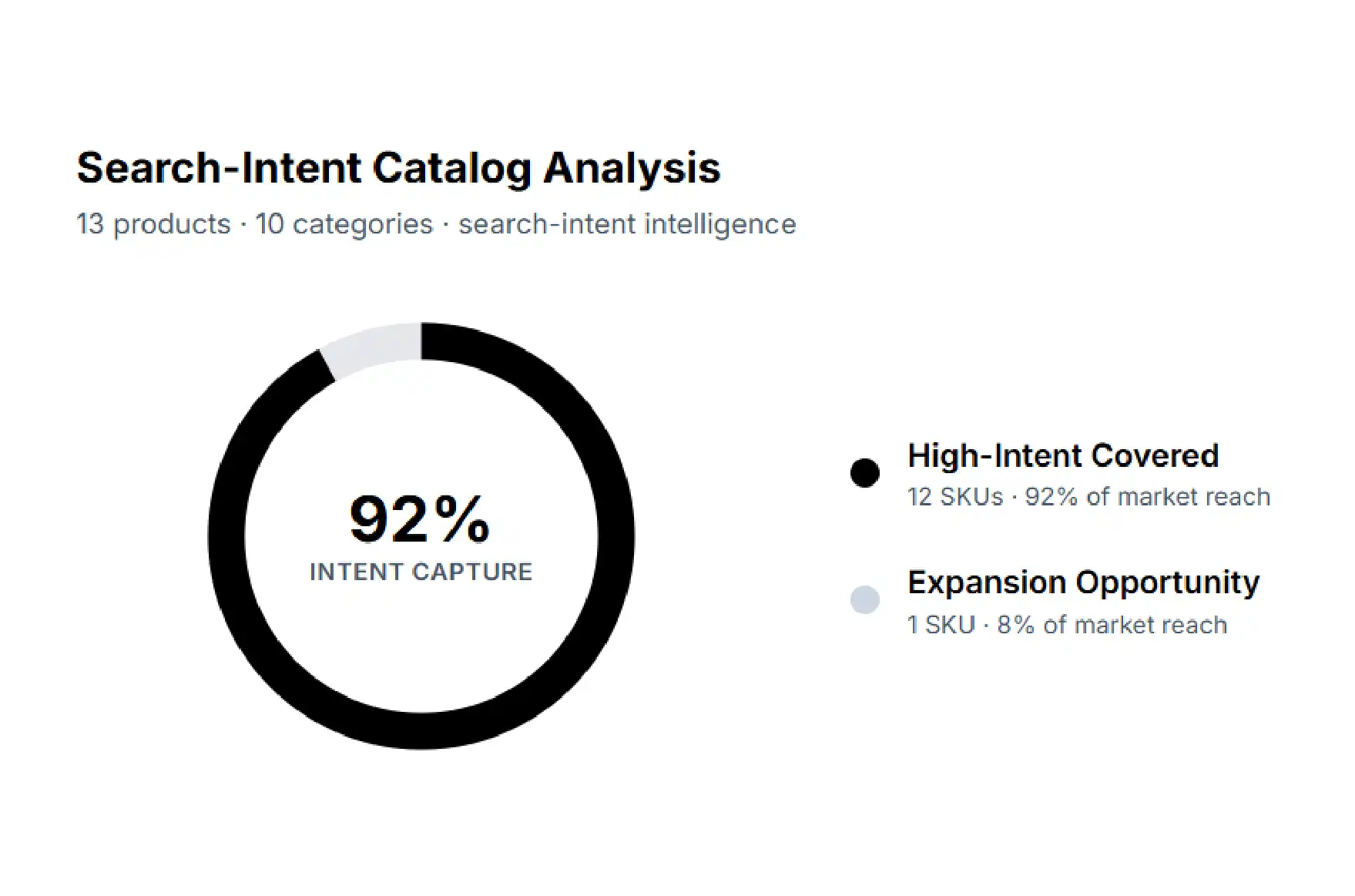
Here is the angle the surface-level breakdown never reaches. Look at the structure: 13 products across 10 categories — almost one product per category. That is the opposite of how most brands operate, where dozens of SKUs crowd into a few categories. Hero's catalog is not built around products; it is built around problems.
Read that way, each SKU functions as a search-intent capture device. A shopper does not browse for a brand — they search for a solution: “blackhead remover,” “mineral sunscreen,” “retinol night cream,” “under-eye cream.” Hero has one strong, highly rated product aimed at each of those high-intent queries, so a tiny catalog covers a wide span of search demand. The brand wins discovery not by having more products, but by having the right product, well-rated, sitting exactly where a buyer with a specific problem is already looking.
That reframes the whole strategy. Hero's edge is search-coverage efficiency: problem-keyword breadth multiplied by per-product trust, rather than catalog size. The lesson for any focused brand is to map your catalog against the high-intent queries in your category and ask whether each SKU owns a distinct search rather than competing with your own listings — a mapping you can only see when every product, category, price, and rating is laid out as one connected picture.
Below is a representative slice of the structured dataset behind this report — the kind of clean, comparable rows our pipeline delivers.
| ASIN | Product | Category | Price | Rating | Reviews | Tier |
|---|---|---|---|---|---|---|
| B07SUNxxxx | Force Shield Superlight Sunscreen SPF 30 | Body Sunscreen | $31.00 | 4.5 | 3,072 | Premium |
| B08PORxxxx | Pore Release Blackhead Clearing Solution | Pore Care | $11.00 | 4.6 | 2,903 | Entry |
| B09RETxxxx | Rescue Retinol Nighttime Renewing Cream | Night Cream | $21.00 | 4.4 | 508 | Treatment |
| B0PATxxxxx | Mighty Patch & Mighty Shield Bundle | Acne Patches | $25.00 | 4.5 | 742 | Treatment |
| B0BALxxxxx | Dissolve Away Daily Cleansing Balm | Cleanser | $11.00 | 4.4 | 615 | Entry |
| B0EYExxxxx | Bright Eyes Illuminating Eye Cream | Eye Cream | $12.00 | 4.5 | 430 | Core |
| B0GLWxxxxx | Glow Balm Radiant Skin Stick | Serum | $11.00 | 4.4 | 289 | Entry |
ASINs shown are illustrative placeholders; values reflect the structure and scale captured during analysis.
The point of an analysis like this is the moves it makes possible. The six findings translate directly into actions a brand or analyst can take this quarter.
None of these require insider information — only the discipline to collect public signals cleanly and read them honestly.
We exist to remove the hardest part of this work: the pipeline. iWeb Data Scraping handles the collection, cleaning, and structure so our clients do not maintain scrapers, fight CAPTCHAs, or wonder whether a blank cell is a real zero or a silent failure. They receive clean, validated, decision-ready data on a schedule that fits their planning cycle.
That means resolved parent-child mapping so formats and review counts are never miscounted, timestamped pricing so your snapshots are defensible, and quality assurance on every record. Whether you need a one-time teardown like this one or continuous coverage across a category, the infrastructure headache is ours, and the insights are yours.
Want to see what this looks like for your category? We will pull a structured 50-product dataset at no cost.
Email info@iwebdatascraping.com with the subject line “Sample Dataset” and tell us the brand or category to analyze.
Start a projectCollecting publicly available product information — prices, ratings, review counts, and listing details — is a widely used practice for market research. We focus only on public data, follow responsible collection practices, and never touch private information. We are happy to discuss your specific use case.
As fresh as you need it. We schedule collection at the cadence that fits your decisions — daily, weekly, or on demand — and timestamp every record so you know exactly when a value was captured.
We resolve parent-child listing relationships explicitly, so size and format variations are mapped correctly and pooled reviews are flagged rather than double-counted. It is one of the most common places DIY scraping goes wrong.
Yes. The same approach applies to Target, Walmart, and other major retailers, plus cross-retailer comparisons. If your category lives across multiple storefronts, we can give you one unified view.
Clean, structured files ready for analysis — typically spreadsheets or a feed into your existing tools, built so a strategist can use it immediately.
It depends on the number of products, refresh frequency, and retailers involved. We scope each engagement to your needs, with predictable pricing and no hidden engineering hours. Reach out for a quote.
We start by signing a Non-Disclosure Agreement (NDA) to protect your ideas.
Our team will analyze your needs to understand what you want.
You'll get a clear and detailed project outline showing how we'll work together.
We'll take care of the project, allowing you to focus on growing your business.