Uncovering News & Updates with iWeb Data Scraping
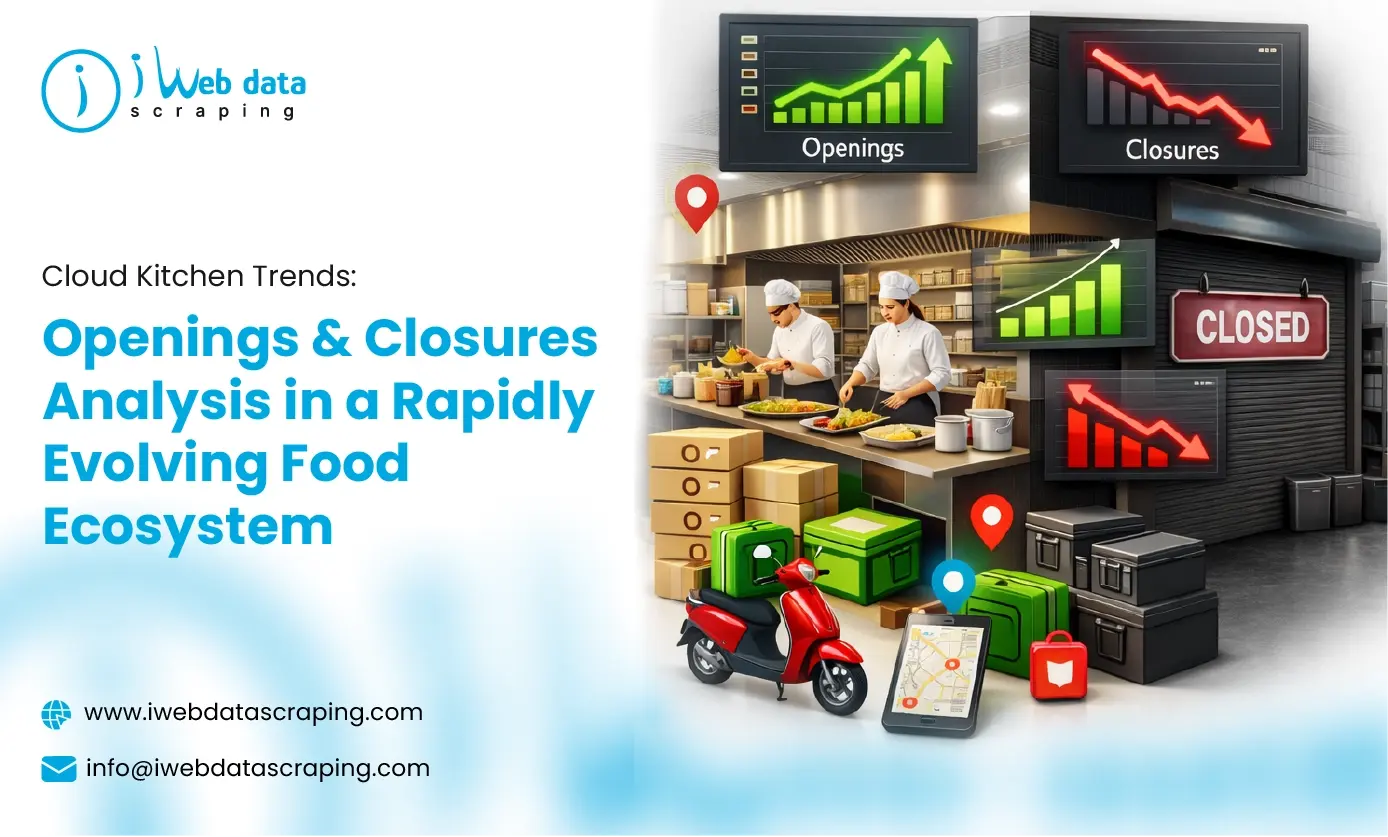
Cloud Kitchen Trends Openings & Closures Analysis in a Rapidly Evolving Food Ecosystem Cloud Kitchen Trends Openings & Closures Analysis uncovering growth hotspots, closure risks, and actionable insights for scalable, data-driven kitchen operations globally.
The cloud kitchen industry is evolving from rapid expansion to a more data-driven, efficiency-focused model. While the sector continues to grow globally, analyzing openings and closures reveals deeper operational realities shaping the market. Investors and operators are now prioritizing profitability over aggressive scaling, making Cloud Kitchen Trends: Openings & Closures Analysis a critical approach for understanding market shifts and identifying sustainable growth opportunities.
Is the Cloud Kitchen Boom Slowing Down or Reshaping?
Cloud kitchen data scraping of Openings & Closures is revealing that although the global market is projected to exceed $44 billion by 2026, nearly 25–30% of newly launched kitchens fail within their first 12–18 months. In India, over 65% of new cloud kitchen launches in 2025 were concentrated in metro cities like Bengaluru, Mumbai, and Delhi, where demand density supports faster delivery cycles. However, the same regions are witnessing closure rates of nearly 18–22% due to rising rental costs, aggregator commissions (ranging between 18–30%), and fluctuating demand patterns.
A closer look shows that multi-brand kitchens are outperforming single-brand setups. Shared infrastructure models reduce operational costs by up to 35%, allowing businesses to experiment with multiple cuisines under one roof. In contrast, single-brand kitchens with limited menu diversity are more vulnerable to demand shifts and competition, leading to faster shutdowns.
Data-Driven Trends Shaping Openings & Closures
To Extract cloud kitchen data for market trend analysis, companies are increasingly relying on structured datasets from food delivery platforms. Insights from 2025–2026 indicate that:
| Location Strategy |
Tier-1 cities dominate new launches |
Tier-2 outskirts show higher shutdown rates |
| Cuisine Trends |
Fast food & combos lead (40% share) |
Niche cuisines face 2x higher failure rate |
| Cost Efficiency |
Shared kitchens reduce cost by 30–35% |
High fixed-cost units struggle to sustain |
| Platform Dependence |
70% rely on aggregators |
High commissions impact margins negatively |
Another emerging pattern is the role of demand volatility. Kitchens that fail to maintain consistent order volumes (minimum 80–100 orders/day) struggle to break even. External factors such as fuel price hikes, supply chain disruptions, and discount wars further accelerate closures.
Role of Real-Time Data in Identifying Market Shifts
Using Web scraping cloud kitchen listings and data, businesses can track real-time indicators of both expansion and decline. For instance, a sudden increase in new listings within a locality often signals a demand surge, while reduced menu size, limited delivery hours, or disappearing listings indicate potential closures.
Data from scraped platforms shows that nearly 35% of new virtual brands launched in 2025 were test concepts introduced within existing cloud kitchens. This “low-risk experimentation” model allows brands to validate demand before committing to full-scale operations. Additionally, high-performing categories such as pizza, biryani, and burgers continue to dominate openings due to their delivery-friendly nature and standardized preparation processes.
From a strategic standpoint, the industry is shifting toward predictive analytics. Operators are leveraging historical and real-time data to identify profitable locations, optimize pricing, and refine menus. This approach is helping reduce failure rates and improve long-term sustainability.
iWeb Data Scraping for Sustainable Cloud Kitchen Growth
In conclusion, the cloud kitchen market is no longer just about rapid growth—it is about smart, data-led expansion. Openings are becoming more calculated, while closures provide critical insights into what doesn’t work. This is where iWeb Data Scraping plays a pivotal role, enabling businesses to continuously track market movements, monitor competitor activity, and identify demand gaps in real time. By integrating such data intelligence into decision-making, companies can better navigate competition, control operational costs, and scale efficiently in this highly dynamic and competitive landscape.