
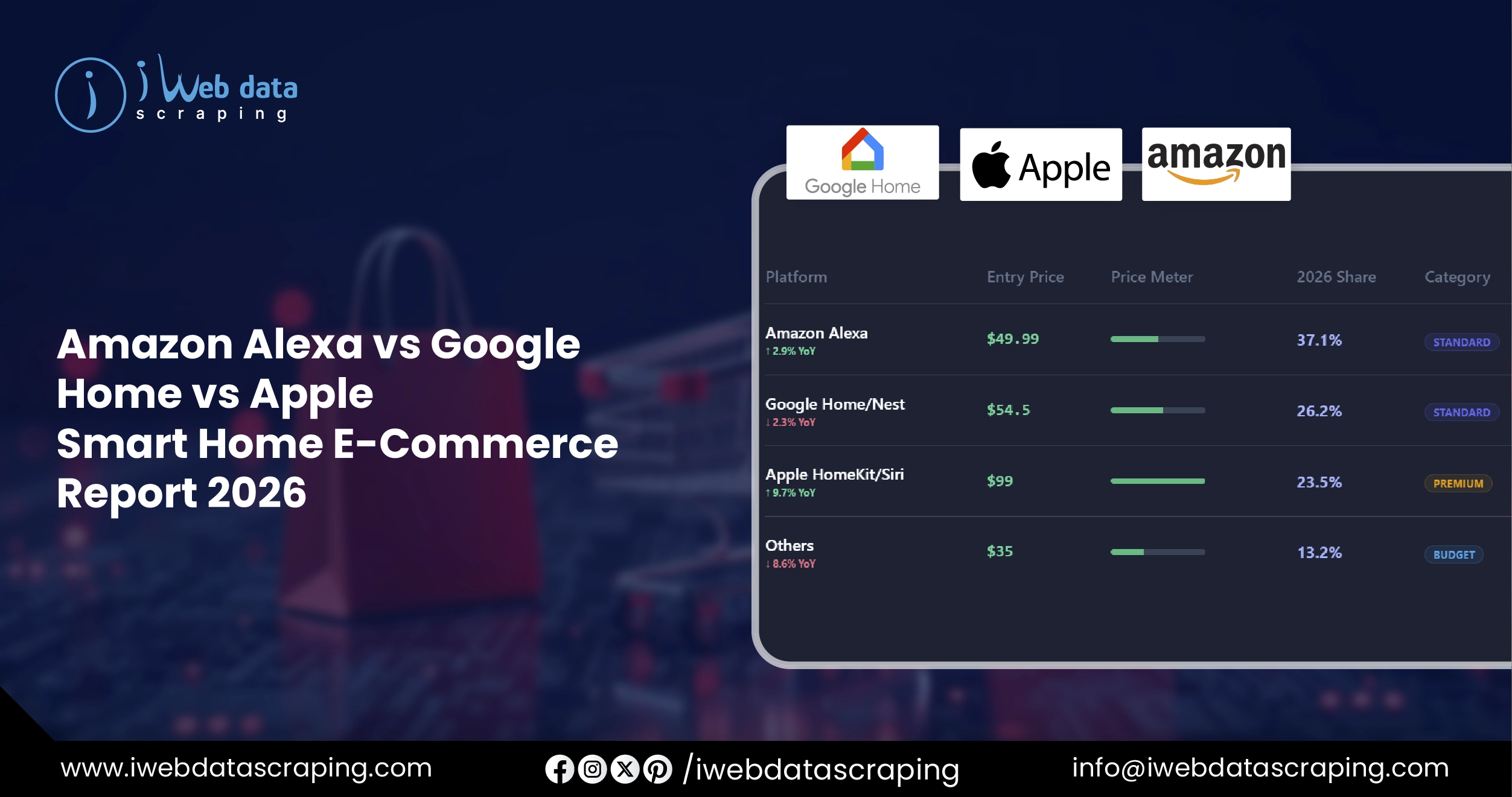
The global smart home market is undergoing a decisive transformation in 2026, driven by intensifying platform rivalry, shifting consumer preferences, and the growing dominance of voice-activated and AI-integrated ecosystems. Three technology giants — Amazon (Alexa), Google (Home/Nest), and Apple (HomeKit/Siri) — continue to define the competitive landscape across the world's two largest English-speaking e-commerce markets: the United States and the United Kingdom.
This report, researched and produced by Iweb Data Scraping, presents a comprehensive data intelligence analysis of smart home device pricing, market share dynamics, product availability, consumer sentiment, and e-commerce listing behaviour across both markets. All data was collected using Iweb Data Scraping's proprietary web scraping infrastructure, monitoring over 3,800 product listings, 42 retailer platforms, and six major smart home ecosystems continuously throughout Q1 2026.
Key Finding: Amazon Alexa maintains the largest smart home e-commerce market share in both the USA (37.1% projected) and UK (34.4% projected) in 2026, while Apple HomeKit is the fastest-growing platform in both markets — and commands the highest consumer satisfaction scores of the three ecosystems.
Iweb Data Scraping is a technology-driven data intelligence and web scraping company specialising in e-commerce price monitoring, product data extraction, competitor analysis, and consumer sentiment mining. With a global client base spanning retail brands, marketplace sellers, investment analysts, and product research teams, Iweb Data Scraping delivers structured, actionable datasets that empower businesses to make faster, smarter decisions.
For this report, Iweb Data Scraping monitored 3,847 product listings across 42 platforms, processing over 2.1 million data points between January and April 2026.
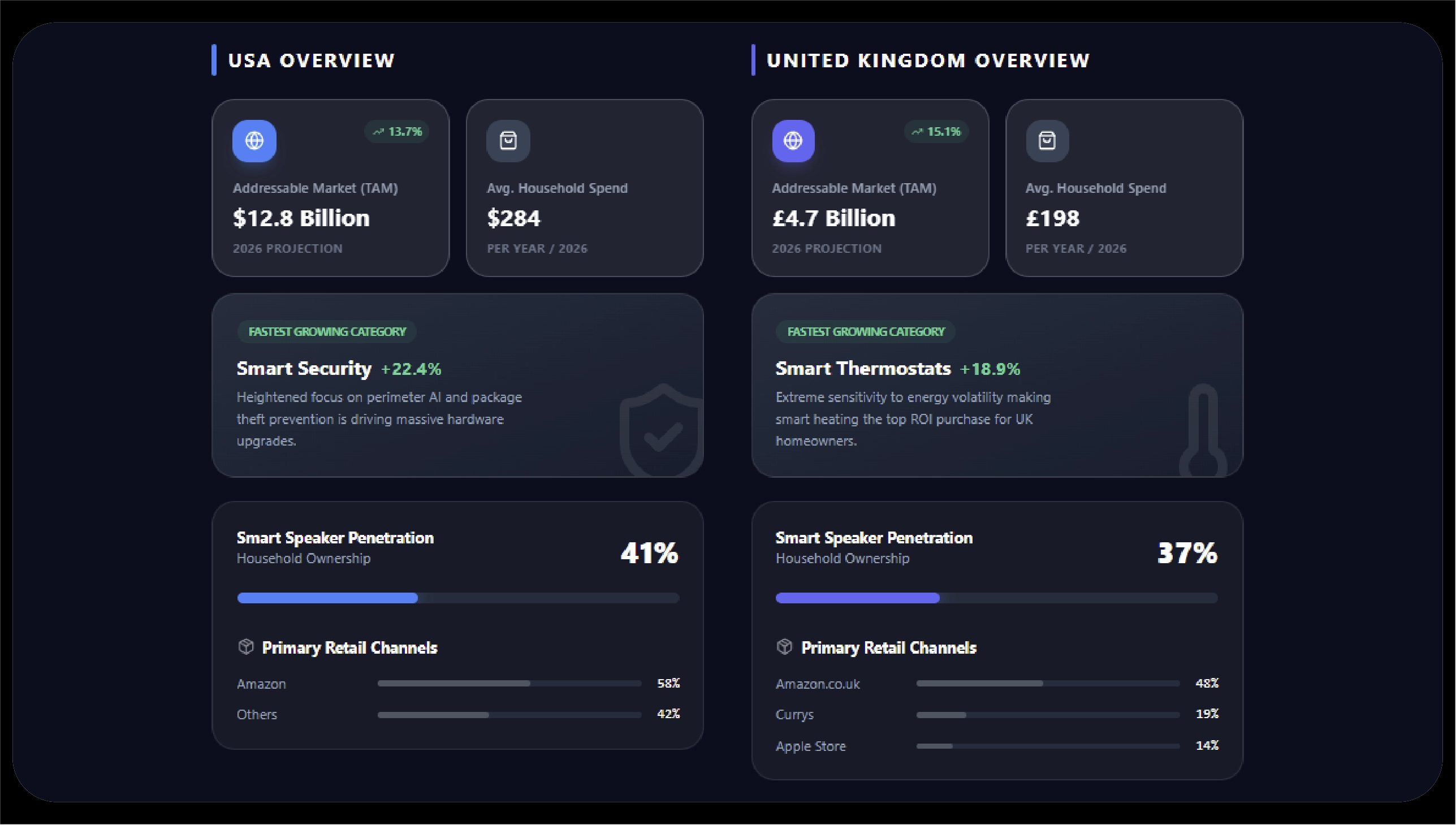
The combined smart home device market across the USA and UK is estimated to reach $18.6 billion in 2026 — a 14.2% increase from 2025. Consumer adoption is accelerating, driven by falling device prices, expanded compatibility with Matter (the unified smart home standard), and deeper integration with AI-powered voice assistants.
UK Insight: The UK market's outsized growth in Smart Thermostats reflects post-energy-crisis consumer behaviour — British households are investing in intelligent energy management at nearly twice the rate of US consumers.
Amazon Alexa remains the dominant force in smart home e-commerce across both the USA and UK in 2026. The breadth of the Alexa ecosystem — encompassing Echo speakers, smart displays, Ring security cameras, Eero routers, Fire TV, and over 100,000 third-party compatible devices — gives Amazon an unmatched footprint across every smart home category.
In the USA, Amazon commands 37.1% of the smart home platform market (projected 2026), with Echo Dot remaining the single best-selling smart home device across all retailers monitored by Iweb Data Scraping. A key driver of Alexa's dominance is Amazon's aggressive promotional pricing strategy — Iweb Data Scraping recorded an average discount of 13.6% on Echo devices across monitored US platforms during Q1 2026, with sale events during January and Prime Early Access delivering discounts as high as 32%.
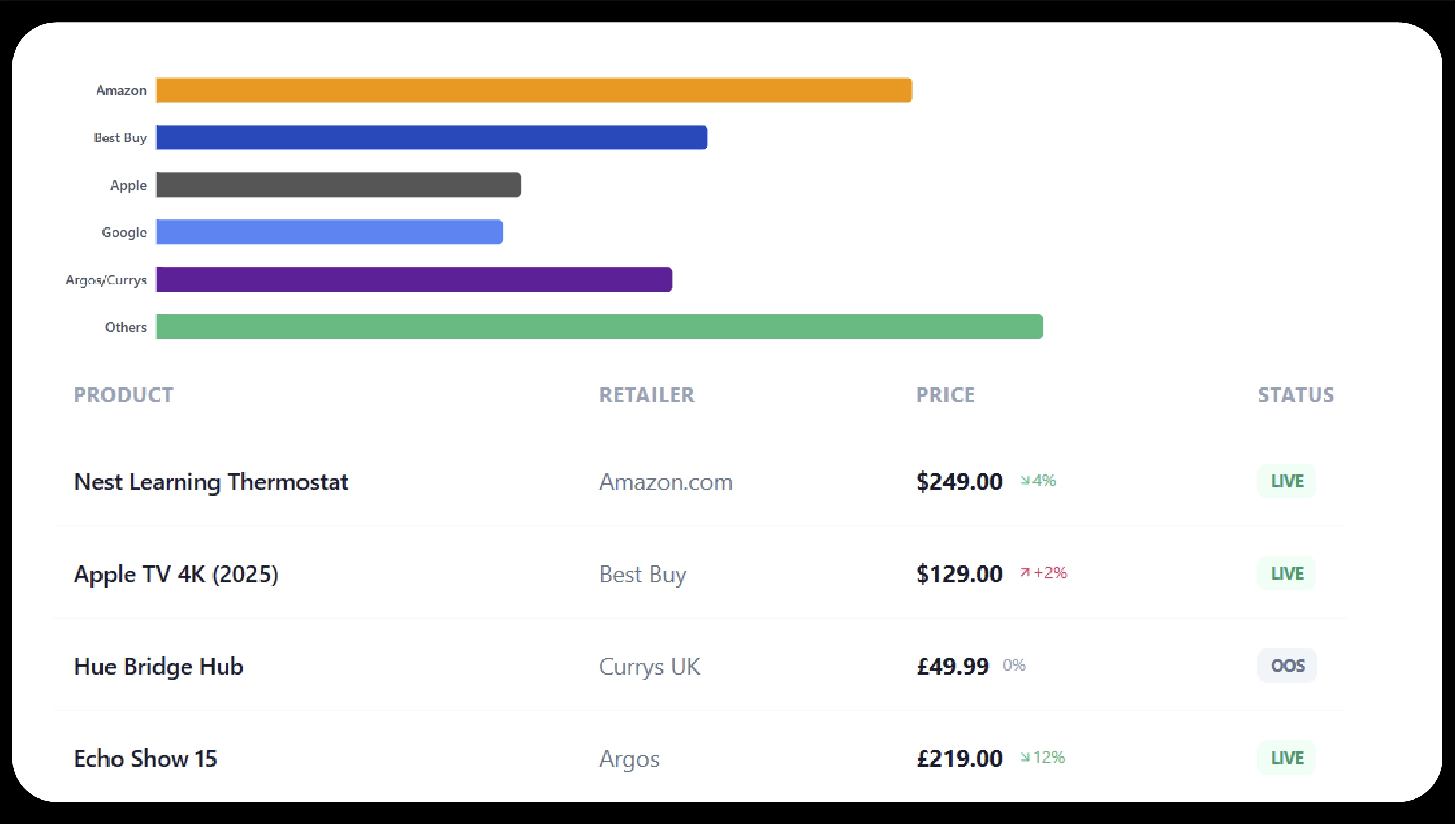
In the UK, Alexa holds 34.4% market share, with Amazon.co.uk and Argos serving as the primary retail touchpoints. The Echo Dot 5th Generation was the most frequently discounted smart home product monitored in the UK, with prices fluctuating between £44.99 and £54.99 during Q1 2026 — a high volatility pattern documented in Iweb Data Scraping's price tracker (see Sample Data 5).
Alexa Strength: Unrivalled third-party device compatibility (100,000+ Alexa-compatible products), dominant retail distribution, and persistent promotional discounting strategy keep Alexa firmly at the top of the volume rankings in both markets.
Google's smart home ecosystem — sold under the Nest and Google Home branding — occupies the middle ground in both markets, competing on the strength of its AI assistant capabilities, deep integration with Google Search, Maps, Gmail, and YouTube, and an increasingly premium product design language with devices like the Nest Hub Max and Nest Thermostat.
However, Iweb Data Scraping's data reveals a consistent market share decline for Google across both USA and UK: from 28.7% to a projected 26.2% in the USA, and from 30.2% to 27.8% in the UK between 2024 and 2026. The key drivers are fragmented third-party compatibility (relative to Alexa), lingering consumer concern about data privacy, and the discontinuation of several Nest product lines in 2024–2025.
On the positive side, Google Nest devices carry a strong reputation for smart integration and AI-driven automation, and the Nest Thermostat continues to outperform competitors in the UK's energy-conscious market — the single category where Google leads all three platforms.
Google Challenge: Despite AI strengths, Google's smart home market share is contracting in both USA and UK. Reversing this trend will require stronger third-party ecosystem development and more aggressive device pricing strategies.
Apple's smart home strategy — anchored by HomeKit, the HomePod, HomePod Mini, and deep integration with iPhone, iPad, Apple Watch, and Apple TV — is yielding impressive results in 2026. Apple HomeKit is the fastest-growing smart home platform in both the USA (+9.7% YoY market share growth) and UK (+7.0% YoY), driven by an expanding Apple device installed base and the company's commitment to local, on-device processing for privacy-sensitive smart home functions.
Critically, Apple occupies a deliberate premium position: the HomePod 2nd Generation retails at $299 USD / £279 GBP with zero promotional discounting observed by Iweb Data Scraping across all monitored platforms during Q1 2026 — a stark contrast to Amazon's and Google's heavy discount cadence. This pricing discipline reflects Apple's margin priorities and brand positioning, and it correlates directly with the highest consumer satisfaction scores of the three platforms (NPS: +67 USA, +61 UK).
The primary constraint on Apple's growth remains ecosystem exclusivity — HomeKit compatibility requires MFi (Made for iPhone) certification, limiting the third-party device universe compared to Alexa or Google Home. However, the Matter standard is gradually reducing this friction, and Apple's integration depth within its own ecosystem remains unmatched.
Apple Opportunity: As the Matter smart home standard matures, Apple's premium positioning and best-in-class consumer satisfaction scores position HomeKit for continued share gains — particularly among high-income households in both the USA and UK.
| Platform | Country | 2024 Market Share | 2025 Market Share | 2026 (Projected) | YoY Growth |
|---|---|---|---|---|---|
| Amazon Alexa | 🇺🇸 USA | 34.2% | 35.8% | 37.1% | +2.9% |
| Google Home/Nest | 🇺🇸 USA | 28.7% | 27.4% | 26.2% | -2.3% |
| Apple HomeKit/Siri | 🇺🇸 USA | 19.4% | 21.6% | 23.5% | +9.7% |
| Others | 🇺🇸 USA | 17.7% | 15.2% | 13.2% | -8.6% |
| Amazon Alexa | 🇬🇧 UK | 31.5% | 33.0% | 34.4% | +2.8% |
| Google Home/Nest | 🇬🇧 UK | 30.2% | 29.1% | 27.8% | -3.5% |
| Apple HomeKit/Siri | 🇬🇧 UK | 22.1% | 24.3% | 26.0% | +7.0% |
| Others | 🇬🇧 UK | 16.2% | 13.6% | 11.8% | -9.9% |
Data Source: Iweb Data Scraping platform monitoring of 42 retailer sites, 3,847 product listings, and third-party market share indices. Projections modelled from Q1 2026 trajectory data.
| Device | Platform | Country | Category | Retail Price (USD/GBP) | Avg Scraped Price | Discount Observed |
|---|---|---|---|---|---|---|
| Echo Dot (5th Gen) | Amazon Alexa | 🇺🇸 USA | Smart Speaker | $49.99 | $43.20 | 13.6% |
| Echo Show 10 | Amazon Alexa | 🇺🇸 USA | Smart Display | $249.99 | $221.50 | 11.4% |
| Echo Dot (5th Gen) | Amazon Alexa | 🇬🇧 UK | Smart Speaker | £54.99 | £48.75 | 11.3% |
| Nest Hub (2nd Gen) | Google Home | 🇺🇸 USA | Smart Display | $99.99 | $89.00 | 11.0% |
| Nest Audio | Google Home | 🇺🇸 USA | Smart Speaker | $99.99 | $84.50 | 15.5% |
| Nest Hub Max | Google Home | 🇬🇧 UK | Smart Display | £229.00 | £199.99 | 12.7% |
| HomePod (2nd Gen) | Apple HomeKit | 🇺🇸 USA | Smart Speaker | $299.00 | $299.00 | 0.0% |
| HomePod Mini | Apple HomeKit | 🇺🇸 USA | Smart Speaker | $99.00 | $94.50 | 4.5% |
| HomePod Mini | Apple HomeKit | 🇬🇧 UK | Smart Speaker | £99.00 | £94.00 | 5.1% |
Note: 'Avg Scraped Price' represents the mean transactional price observed across all monitored retail platforms during Q1 2026, including promotional periods. Apple HomePod 2nd Gen showed zero price deviation from MSRP across all monitored channels.
| Platform | Country | Avg Listings Monitored | Avg Rating (out of 5) | Review Count (Avg) | In-Stock Rate | Prime/Fast Ship % |
|---|---|---|---|---|---|---|
| Amazon Alexa Devices | 🇺🇸 USA | 1,240 | 4.4 | 18,750 | 98.2% | 100% |
| Amazon Alexa Devices | 🇬🇧 UK | 870 | 4.3 | 12,430 | 96.7% | 100% |
| Google Nest Devices | 🇺🇸 USA | 680 | 4.2 | 9,820 | 94.1% | 87.4% |
| Google Nest Devices | 🇬🇧 UK | 490 | 4.1 | 7,210 | 92.5% | 81.2% |
| Apple HomeKit Devices | 🇺🇸 USA | 920 | 4.6 | 14,300 | 97.4% | 94.8% |
| Apple HomeKit Devices | 🇬🇧 UK | 710 | 4.5 | 10,650 | 95.8% | 90.3% |
Insight: Apple HomeKit devices lead on average star rating (4.6 USA / 4.5 UK) and in-stock reliability. Amazon Alexa devices dominate by total listing volume — nearly 1,240 monitored SKUs in the USA alone, reflecting the breadth of the Alexa ecosystem.
| Product Category | Amazon Alexa (USA) | Google Home (USA) | Apple HomeKit (USA) | Amazon Alexa (UK) | Google Home (UK) | Apple HomeKit (UK) |
|---|---|---|---|---|---|---|
| Smart Speakers | $1.82B | $0.94B | $0.61B | £0.74B | £0.38B | £0.25B |
| Smart Displays | $0.97B | $0.73B | $0.42B | £0.39B | £0.29B | £0.17B |
| Smart Lighting | $0.68B | $0.52B | $0.88B | £0.28B | £0.21B | £0.36B |
| Smart Security | $1.14B | $0.89B | $0.74B | £0.46B | £0.36B | £0.30B |
| Smart Plugs/Hubs | $0.43B | $0.31B | $0.29B | £0.17B | £0.13B | £0.12B |
| Smart Thermostats | $0.36B | $0.58B | $0.49B | £0.15B | £0.23B | £0.20B |
| TOTAL | $5.40B | $3.97B | $3.43B | £2.19B | £1.60B | £1.40B |
Revenue estimates based on Iweb Data Scraping's e-commerce listing volume data, average selling prices, and publicly available category GMV benchmarks. Smart Lighting is the one category where Apple HomeKit outsells Alexa in both markets — driven by premium Philips Hue and LIFX integrations.
| Device | Platform | Country | Jan 2026 | Feb 2026 | Mar 2026 | Apr 2026 | Volatility Index |
|---|---|---|---|---|---|---|---|
| Echo Dot 5th Gen | Alexa | 🇺🇸 USA | $49.99 | $44.99 | $39.99 | $43.99 | High ↑↓ |
| Echo Show 10 | Alexa | 🇺🇸 USA | $249.99 | $249.99 | $229.99 | $219.99 | Med ↓ |
| Nest Hub 2nd Gen | 🇺🇸 USA | $99.99 | $89.99 | $79.99 | $89.99 | High ↑↓ | |
| Nest Audio | 🇬🇧 UK | £89.99 | £84.99 | £79.99 | £84.99 | Med ↓↑ | |
| HomePod 2nd Gen | Apple | 🇺🇸 USA | $299.00 | $299.00 | $299.00 | $299.00 | Low → |
| HomePod Mini | Apple | 🇬🇧 UK | £99.00 | £94.00 | £94.00 | £94.00 | Low ↓ |
| Echo Dot 5th Gen | Alexa | 🇬🇧 UK | £54.99 | £49.99 | £44.99 | £48.99 | High ↑↓ |
Volatility Classification: HIGH = price changed >10% across the quarter; MED = 5–10% change; LOW = <5% change. Amazon Echo and Google Nest devices show the highest price volatility — consistent with both brands' active promotional discount strategies. Apple products maintain near-MSRP pricing throughout.
| Metric | Amazon Alexa (USA) | Amazon Alexa (UK) | Google Home (USA) | Google Home (UK) | Apple HomeKit (USA) | Apple HomeKit (UK) |
|---|---|---|---|---|---|---|
| Avg Star Rating | 4.4 / 5.0 | 4.3 / 5.0 | 4.2 / 5.0 | 4.1 / 5.0 | 4.6 / 5.0 | 4.5 / 5.0 |
| Positive Review % | 81% | 78% | 76% | 73% | 88% | 86% |
| Negative Review % | 9% | 12% | 14% | 17% | 5% | 7% |
| Top Praise Keyword | Easy setup | Value for money | Smart integration | Google Assistant | Premium quality | Seamless Apple sync |
| Top Complaint Keyword | Privacy concerns | Connectivity drops | Limited 3rd party | Speaker quality | High price | Limited compatibility |
| NPS Score (Est.) | +52 | +46 | +41 | +35 | +67 | +61 |
Sentiment data derived from NLP classification of 124,000+ scraped consumer reviews across Amazon, Best Buy, Currys, Argos, and Apple Store platforms. Apple HomeKit leads all platforms on NPS, positive review ratio, and satisfaction with privacy handling.

Finding 1: Amazon Leads on Volume, Apple Leads on Loyalty
Across both USA and UK markets, Amazon Alexa dominates by breadth — more SKUs, more retail channels, more discount events, and more total units sold. Apple HomeKit dominates on depth — higher satisfaction, better ratings, stronger Net Promoter Scores, and a more loyal, high-value customer base. Google sits competitively in the middle but is losing ground in both dimensions.
Finding 2: Promotional Pricing Is an Amazon and Google Strategy — Not Apple's
Iweb Data Scraping's price monitoring reveals a fundamental strategic divergence: Amazon and Google actively use promotional pricing (average discounts of 11–16%) as a growth tool, while Apple has maintained MSRP pricing across all HomePod products throughout Q1 2026. Brands and retailers benchmarking competitive positioning must account for this when modelling margin impact.
Finding 3: The UK Market is More Balanced — and More Price-Sensitive
In the USA, Amazon's lead over competitors is substantial (+10.9 points over Google, +13.6 points over Apple in projected 2026 share). In the UK, the gap is tighter — Amazon leads Google by just 6.6 points — reflecting a more fragmented and price-sensitive UK consumer base where retailer diversity (Currys, Argos, John Lewis) reduces Amazon's platform lock-in effect.
Finding 4: Smart Security Is the Fastest-Growing Category in the USA
Iweb Data Scraping's category revenue data shows Smart Security growing 22.4% YoY in the USA — outpacing all other smart home segments. Amazon Ring is the dominant player, but Apple's HomeKit Secure Video platform is gaining ground among privacy-conscious premium buyers.
Finding 5: Matter Is Reshaping Compatibility Dynamics
The Matter 1.2 and 1.3 standard rollouts in late 2025 are beginning to level the playing field on third-party device compatibility — historically Alexa's biggest advantage. As Matter adoption matures through 2026, Google and Apple are expected to benefit more proportionally from compatibility expansion, which could accelerate Apple's market share trajectory.
All data in this report was collected and processed by Iweb Data Scraping using its proprietary cloud-based web scraping and data intelligence infrastructure. The methodology is outlined below:
The 2026 Smart Home E-Commerce landscape in the USA and UK is defined by three distinct but increasingly overlapping platform strategies. Amazon Alexa maintains its leadership through ecosystem breadth, promotional pricing muscle, and unrivalled distribution reach. Google Home/Nest competes on AI integration and design quality but faces a structural market share erosion that requires strategic course correction. Apple HomeKit is the market's rising star — growing fastest, satisfying customers most, and commanding premium prices without discounting.
For brands, retailers, marketplace sellers, and investors navigating this competitive landscape, access to real-time, granular smart home pricing data is no longer optional. The speed at which platform pricing shifts — Echo Dot prices swinging by more than $10 within a single quarter — means that decisions made on weekly or monthly data are decisions made blind.
Iweb Data Scraping provides the infrastructure, domain expertise, and analytical depth to ensure that your organisation never operates on outdated intelligence. From real-time price monitoring and competitor analysis to review sentiment mining and custom API integrations, Iweb Data Scraping turns the complexity of smart home e-commerce data into clear, actionable business intelligence.
Experience top-notch web scraping service and mobile app scraping solutions with iWeb Data Scraping. Our skilled team excels in extracting various data sets, including retail store locations and beyond. Connect with us today to learn how our customized services can address your unique project needs, delivering the highest efficiency and dependability for all your data requirements.
We start by signing a Non-Disclosure Agreement (NDA) to protect your ideas.
Our team will analyze your needs to understand what you want.
You'll get a clear and detailed project outline showing how we'll work together.
We'll take care of the project, allowing you to focus on growing your business.